
Last week we found a NAP inconsistency on our own listing. Google had our address as 2223 E 19th St. Our website said 2223 East 19th Street. Same building, same business, two different strings, and we do this for a living.
That is the whole problem with NAP consistency. It is trivially boring, nobody enjoys auditing it, and it quietly caps how well a local business can rank no matter what else gets done.
Here is what it actually is, why one small variant multiplies into hundreds, and the order to fix it in.
What NAP means, and why Google cares
NAP is Name, Address, Phone. The three facts that identify a business as a real place rather than a website claiming to be one.
Google’s guidelines for representing your business are strict about this, and its local ranking documentation names prominence as one of three ranking factors, alongside relevance and distance. Prominence is partly built from how consistently the web describes your business.
The mechanism is confidence. Google is not grading your tidiness. It is deciding how certain it can be that the business exists, is open, and is where it claims to be. Every source agreeing raises that certainty. Every conflicting source lowers it.
Low confidence does not produce an error message. It produces a listing that ranks slightly worse than it should, forever, for no visible reason.
How one variant becomes forty
Most business owners assume a wrong address on some directory is a small, contained problem. It is neither.
Three data aggregators supply business records to most of the ecosystem: Data Axle, Foursquare and Neustar Localeze. Apple Maps, Bing, Yelp, Yellow Pages, MapQuest and hundreds of smaller sites pull from them.
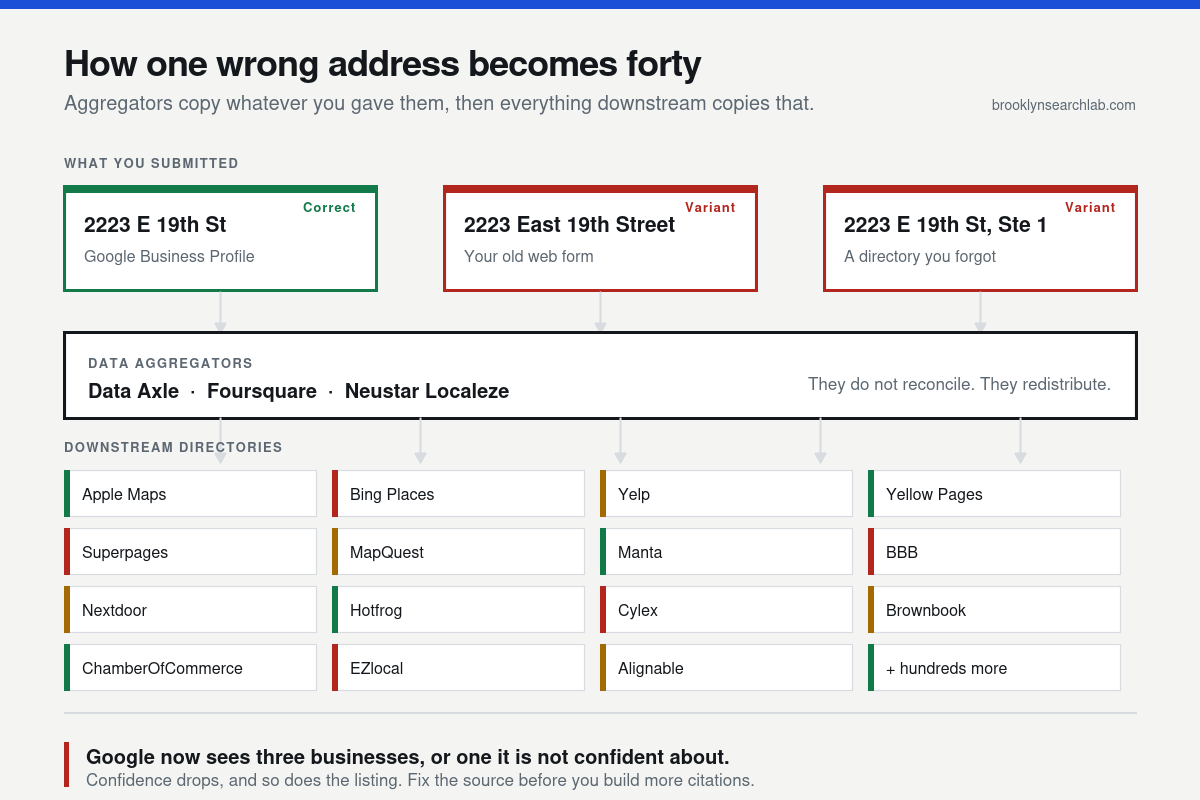
Aggregators do not reconcile conflicting submissions. They redistribute them. Submit one variant to one aggregator and it propagates to dozens of sites you have never heard of and cannot easily edit.
This is why order matters more than effort. Building fifty citations before your details are settled does not give you fifty citations. It gives you fifty corrections, spread across sites with different login systems, support queues and update cycles.
What actually counts as an inconsistency
Stricter than most people expect. These are all treated as different values:
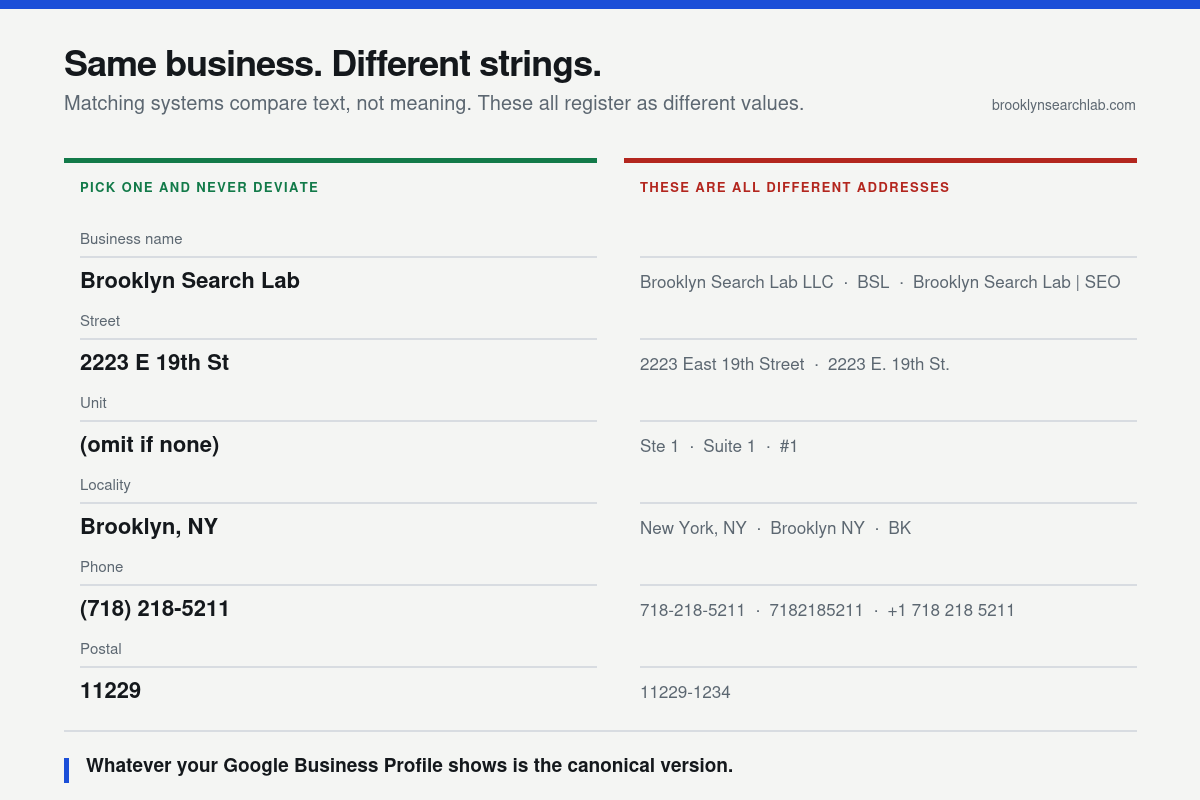
Street abbreviations. “E 19th St” and “East 19th Street” are different strings. So are “Ave” and “Avenue”, “Blvd” and “Boulevard”. Pick whichever form your Google Business Profile uses and never deviate.
Suite and unit numbers. “Ste 200”, “Suite 200”, “#200” and omitting it entirely are four different addresses.
Phone formatting. Less critical than it once was, because most systems normalise digits. Still worth standardising on one visible format.
Business name. The most damaging one. “Brooklyn Search Lab” and “Brooklyn Search Lab LLC” are different businesses as far as matching is concerned. Adding keywords is worse still, and is a common cause of listing suspension.
Tracking numbers. Call-tracking numbers on your website that differ from your Google listing actively create inconsistency. Use the real number as primary and tracking numbers as secondary.
The New York problem nobody warns you about
NYC creates a locality ambiguity that does not exist in most cities: Brooklyn is a borough, not a city, but it functions as one for addressing.
The USPS accepts “Brooklyn, NY 11229”. Plenty of software wants “New York, NY”. Some directories auto-correct one into the other. Business owners often list “New York, NY” believing it sounds more impressive, and end up with a locality mismatch against their own Google listing.
Use the borough. Brooklyn, Queens, Bronx and Staten Island addresses should say the borough, because that is what USPS uses and what Google has. The same discipline applies to the name field, where Google enforcement broke rankings across half of NYC for profiles carrying a name that did not match the signage. Only Manhattan uses “New York, NY”.
This compounds with something we wrote about previously: proximity already limits how far your map pack reach extends. If your listing is also fighting locality confusion, you are weakening the one factor you can control inside a radius you cannot. It is why SEO in Brooklyn and SEO in Manhattan are genuinely different jobs rather than the same page with a word swapped.
Fix the source before you build anything
The part most guides skip. There is a correct order, and doing it backwards multiplies your work.
1. Decide the canonical string
One version of name, address and phone. Whatever your Google Business Profile shows is the source of truth, because that is the listing Google reconciles everything else against.
2. Fix your own website first
Footer, contact page, and your LocalBusiness structured data. Your site is the most authoritative source about you, and its PostalAddress markup states your NAP in a machine-readable form. If your own markup disagrees with your listing, nothing downstream can be trusted.
3. Audit before you add
Search your phone number in quotes. Search your business name plus your street. You will find listings you never created, because aggregators generate them from public records.
4. Correct the aggregators, then wait
Fix Data Axle, Foursquare and Neustar first, then give it several weeks. Downstream sites refresh on their own schedules. Correcting a downstream directory before the aggregator will simply be overwritten.
5. Only then build new citations
With one canonical string, in the order that lets aggregators do the distribution for you. Which directories still earn that effort is a much shorter list than it used to be, and we tested it in citation building for NYC businesses.
Service-area businesses have it harder
If you hide your address on Google because you travel to customers rather than receiving them, NAP consistency gets stranger, and most advice ignores this entirely.
A service-area business has an address Google knows but does not display. That creates a genuine dilemma: your listing shows no street address, so what should your website and your directory profiles show?
The answer is to match what is public. If Google hides your address, your citations should show city and state only, and the fuller comparison of the two listing types sits in service area business vs. storefront. Publishing a street address across forty directories while your Google listing shows none is exactly the kind of disagreement that costs confidence. It also risks a suspension review, because Google can see the mismatch between what you told it privately and what you are publishing publicly.
The corollary matters too. If you later switch to a visible storefront address, that is not a small edit. It is a change to your canonical NAP, and every citation built under the old arrangement needs revisiting. Decide which model you are before building citations, not after.
Businesses running more than one pin have this problem multiplied across every location, which is a large part of why multi-location businesses lose to single-location competitors on Google Maps.
We work through this on every Google Business Profile engagement, because getting it wrong is one of the few local SEO mistakes that can remove your listing entirely rather than merely weaken it.
Key takeaways
- Your Google Business Profile is the source of truth. Match everything to it, not the other way round.
- Abbreviations matter. “E 19th St” and “East 19th Street” are different addresses to a matching system.
- Aggregators redistribute, they do not reconcile. One bad submission reaches hundreds of sites.
- Use the borough, not “New York, NY”, unless you are actually in Manhattan.
- Fix before you build. Citations created before your details are settled become corrections.
- Nothing tells you it is broken. There is no warning. The listing just underperforms quietly.
What to do this week
- Write down your canonical NAP, copied character for character from your Google Business Profile. Keep it somewhere you can paste from.
- Check your own website against it. Footer, contact page, schema markup. Fix any variance today.
- Search your phone number in quotes. Note every listing that appears, including ones you did not create.
- Check the big four you probably already have: Google, Bing, Yelp, Facebook. These carry the most weight and are the most likely to be stale.
- Fix the aggregators, then stop. Wait several weeks before building anything new.
Common questions
How much does NAP consistency actually affect rankings?
It is a floor rather than a lever. Consistency will not push you past a stronger competitor, but inconsistency will quietly hold you below where you should sit. It is foundational work, not growth work, and it is cheap compared with what it protects.
Do I need a paid citation management service?
For a single location, usually not. The three aggregators plus ten to fifteen good directories can be done by hand in a few sessions. Multi-location businesses are a different calculation, because the manual work scales badly.
What about listings I never created?
Common. Aggregators generate records from public data. Claim them where you can and correct them. Where you cannot claim, most directories have a “suggest an edit” route.
Should I use a call tracking number?
Only carefully. Keep your real number as the primary on every listing and use tracking numbers as secondary, or use dynamic insertion that swaps the number for visitors while search engines see the real one.
How long until fixes take effect?
Aggregator corrections take six to twelve weeks to propagate. Google Business Profile edits can appear within days. Do not expect ranking movement in the first month.
Is this worth it if I only serve one neighbourhood?
Yes, and arguably more. In a tight radius the competitive set is small and every prominence signal is proportionally larger. Consistency is one of the few you fully control.
Not sure what is out there about your business?
The free technical audit includes a citation and NAP consistency check: where your business is listed, which records disagree, and what to fix in what order. Five business days, no obligation, yours to keep.
Related: Google Business Profile optimization, SEO services, areas we serve.