
The first citation inconsistency we had to fix in 2026 was our own. Our GitHub organisation carried one email address, the website footer carried another, and the address was written out in full in two places and abbreviated in a third. Nothing about that was visible on the site, nothing was broken, and nobody would ever have complained. It was still three separate versions of the same business sitting in public, waiting to be read by something that has no way of asking us which one is right.
That is what citation work is now. It is not a submissions exercise, and it stopped being a volume game a long time before most of the packages sold in 2026 stopped being priced like one.
What a citation is actually doing now
A citation is any public mention of your business name, address and phone number, whether or not it links to you. In 2010 the value was discovery: Google leaned on directory data to learn that a business existed at all. That is no longer the relationship. Your Google Business Profile is now the primary record, and directories are secondary.
What they still do is corroborate. Google is explicit that it assembles business information from a range of third-party sources alongside what you enter yourself, and that its local results are influenced by prominence, which includes information about your business from across the web. The useful mental model is not a ballot box where each directory casts a vote. It is a set of independent records that either agree with each other or do not.
When they agree, your business is a settled fact. When they disagree, you are an unresolved question, and there is no mechanism anywhere for you to explain the discrepancy. This is the same argument we made about NAP consistency being the boring fix that actually moves rankings, and citations are simply where that consistency lives or dies at scale.
The propagation problem nobody budgets for
Here is the part that makes most citation cleanup a waste of money. The directory you just corrected by hand is very often not the source of its own data. It is a downstream consumer of a feed.
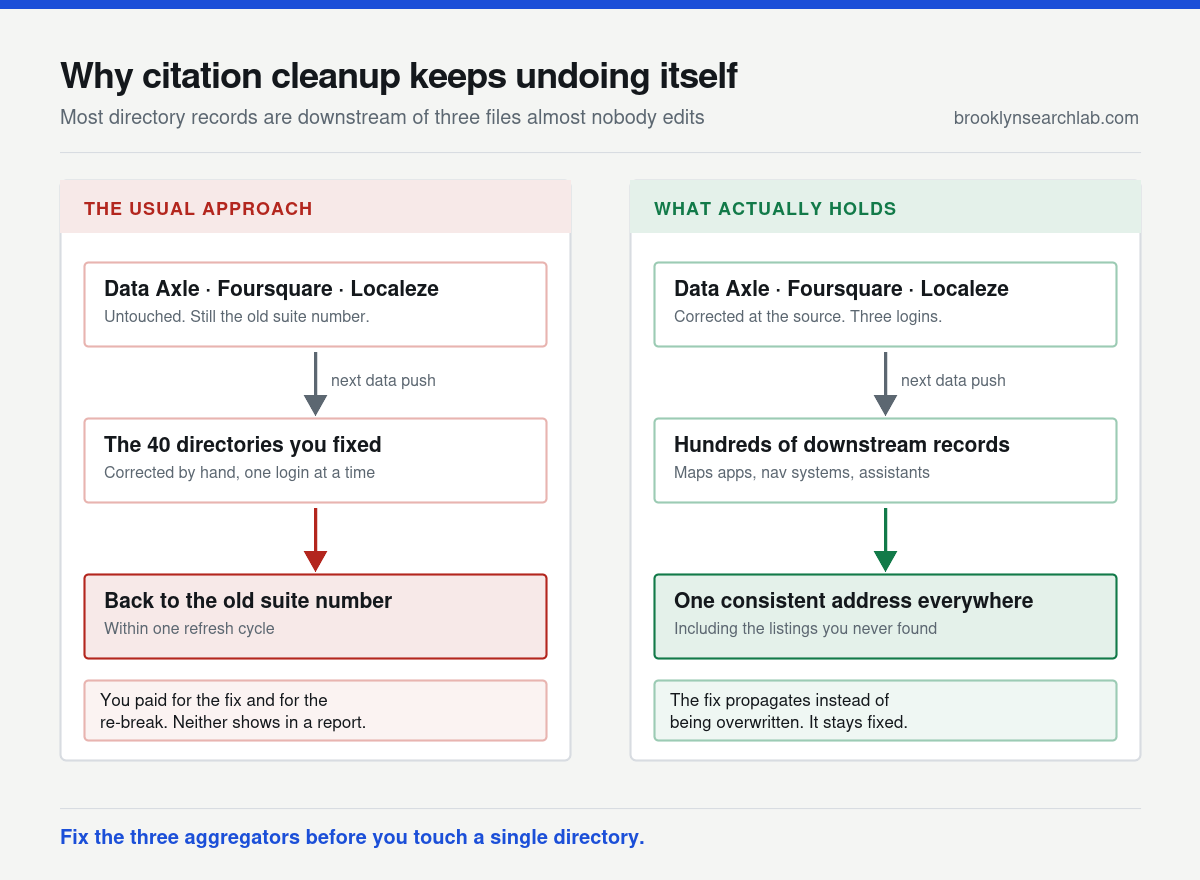
Three data aggregators sit above most of the US local ecosystem: Data Axle, Foursquare and Neustar Localeze. Between them they supply the business records that appear in maps apps, in-car navigation, voice assistants and a long tail of directory sites that never collect anything themselves. Correct forty of those downstream sites by hand and you have done real work that expires. On the next refresh cycle, the aggregator pushes the old suite number back down and quietly undoes it.
This is why citation audits often show a business getting worse between reports. Nothing regressed. The cleanup was applied at the wrong altitude, and the upstream record was still telling everyone the original story.
Fixing the three aggregators first is unglamorous, takes an afternoon, and cannot be sold as a monthly retainer, which is a decent explanation for how rarely it leads the proposal.
The stack: five tiers doing five different jobs
Once you stop counting citations, the question changes from how many to which, and the tiers turn out to be doing genuinely different work.
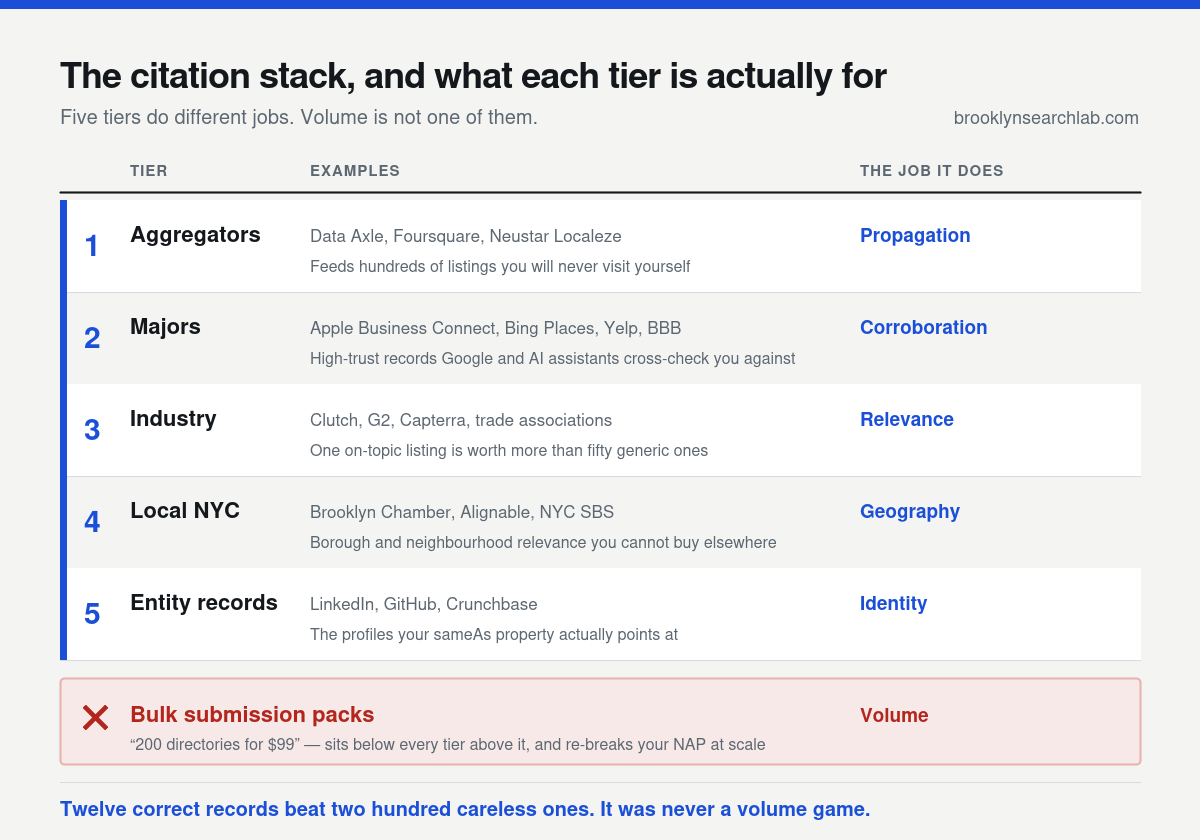
Read down the column on the right and the sequencing writes itself. There is no point buying relevance in tier three while tier one is still broadcasting the wrong address, and no point at all in the row at the bottom.
Why New York makes this harder than almost anywhere
Every city has address data. New York has address data that fights back.
The abbreviation problem is real and it is ours. Our own address is 2223 E 19th St, exactly as Google holds it. Written out as 2223 East 19th Street it is the same building and a different string, and there is no shortage of directories that will normalise it one way while their upstream feed normalises it the other. The USPS Publication 28 addressing standards are the closest thing to an arbiter here, and picking one canonical form and never varying it matters more than picking the right one.
Neighbourhood names are not administrative units. A single Brooklyn ZIP code can carry three neighbourhood names that locals use interchangeably and directories treat as different places. Choosing to describe yourself as being in one of them is a positioning decision, not a data-entry decision, and it needs to match what you say on your Brooklyn SEO pages.
Shared buildings generate duplicates. Density means many businesses at one address, and a shared or virtual office is where citation work turns into a suspension risk. Google’s guidelines for representing your business are unambiguous that the address must be one where you are staffed during your stated hours. Citations that assert an address you cannot defend are not neutral; they are evidence.
Borough geography changes what the work is for. Citations feed prominence, and prominence only matters after the map pack’s earlier cuts, as we covered in the map pack ranking factors nobody tells small business owners about. From a pin in southern Brooklyn, that means citation work supports a realistic map pack push locally while doing something different for Manhattan SEO, where the play is organic and the citations are working as trust signals rather than proximity ones.
What to fix, and in what order
1. Write the canonical string first
One document, one version of the name, address, phone, hours and email. Every profile is filled from that document and nothing else. This sounds trivially obvious and it is the step almost everyone skips, which is how a business ends up with two email addresses in public, as ours did.
2. The three aggregators, before anything downstream
Data Axle, Foursquare and Neustar Localeze. Foursquare is worth understanding in particular, since it feeds Apple Maps and a long list of apps you will never audit directly.
3. The majors that get missed
Apple Business Connect is the single most commonly skipped high-value listing we see. It is free, it takes twenty minutes, and it governs how you appear to every iPhone user who asks Siri for directions. Bing Places, Yelp, the Better Business Bureau and Nextdoor round out the tier, and Nextdoor carries unusual weight at the neighbourhood level in Brooklyn.
4. Industry directories before generic ones
One listing on a directory your customers actually use outperforms fifty on sites nobody visits. The test is whether a real prospect could plausibly arrive from it. If not, the only thing it is contributing is another record that can drift out of sync.
5. Entity records, and the property that points at them
LinkedIn, GitHub and Crunchbase are not directories in the local sense, but they are the profiles a sameAs property points to in your LocalBusiness structured data. That is the explicit statement connecting your website to your identity elsewhere, and it is worth more than a dozen generic listings. For anyone selling technical work, a real GitHub organisation is a disproportionately strong signal.
The second audience is no longer a search engine
Here is the shift that changes how this work should be scoped. For fifteen years the only reader of your citations was Google, and the only question was whether they helped you rank. That is no longer the only question, because a growing share of the people looking for a local business never see a result page at all. They ask an assistant, and the assistant answers from whatever it can retrieve and reconcile about you.
Retrieval systems have the same problem Google has, without the fifteen years of local-specific machinery for resolving it. Given three plausible addresses for one business, a language model does not investigate. It picks one, hedges, or omits you from the answer entirely because a competitor’s facts were easier to state confidently. Consistency has quietly stopped being a ranking input and started being a precondition for being quotable.
Which reframes the deliverable. The output of citation work is not a spreadsheet of submissions. It is a business that resolves to one unambiguous answer everywhere it is described. We treat that as a data problem rather than an admin problem, and monitor it the same way we would any other dataset that drifts, which is closer to structured data extraction than to marketing. That combination of search work and engineering is the whole reason Google Business Profile optimization and location strategy sit next to each other here rather than in separate departments.
Key takeaways
- Citations corroborate, they do not vote. Agreement between independent records is the entire mechanism.
- Fix the three aggregators first. Downstream corrections get overwritten on the next data push, and the report never shows it.
- Five tiers, five jobs. Propagation, corroboration, relevance, geography, identity. Volume is not on the list.
- Apple Business Connect is the most-missed free listing we find on New York profiles.
- New York punishes address ambiguity through abbreviations, overlapping neighbourhood names and shared buildings.
- Your second audience is an AI assistant that will omit you rather than resolve a contradiction.
What to do this week
- Write the canonical NAP block. One version of name, address, phone, hours and email, copied from your Google Business Profile exactly as Google holds it, abbreviations included.
- Search your phone number in quotes. Every result is a citation you may not know you have. Note the ones carrying a wrong address.
- Claim or correct the three aggregators. Data Axle, Foursquare, Neustar Localeze. Localeze blocks automated access, so use a browser.
- Set up Apple Business Connect. Twenty minutes for every iPhone user in your service area.
- Check your
sameAsproperty. If your structured data does not list your real LinkedIn and GitHub profiles, it is not doing the one job it exists for. - Diarise a re-check for ninety days. Aggregator feeds refresh, and the point of fixing upstream is that you get to verify rather than redo.
Common questions
How many citations do I actually need?
Fewer than you have been sold. A dozen correct, on-topic, correctly tiered records outperform two hundred careless ones, and the careless ones carry an ongoing cost because every one of them can drift.
Do paid citation packages ever make sense?
Rarely, and never as a first move. The risk is not the money, it is that bulk submission introduces variations of your address at a scale you cannot then audit. If you buy one, insist on the exact canonical string and a full list of where it was submitted.
Should I remove old citations with the wrong address?
Correct them where you can, remove them where you cannot. An abandoned listing with a former address is actively contradicting your current one, which is worse than not existing.
Do citations still help if the listing has no link?
Yes. An unlinked mention of your name, address and phone still corroborates the record. The link is a separate benefit, not the point of the exercise.
What about reviews on directory sites?
Useful for conversion and largely separate from the citation question. Google’s own review count is the one that interacts with local ranking, which we looked at in how many Google reviews you actually need in NYC.
I am a service area business with no public address. Does any of this apply?
It applies more, not less, because you have fewer corroborating signals to work with and the address field behaves differently. Start with how service area and storefront setup differ, then keep the hidden address consistent everywhere it is stored, even where it is never displayed.
Find out what the web is currently saying about you
The free audit includes a citation sweep: where your business appears, which records disagree with your Google Business Profile, which of them are upstream and which are simply repeating a feed, and what a corrected sequence would cost. Five business days, no obligation.
Related: Google Business Profile optimization, SEO in Brooklyn, who we are.