
Here is something you can check in ninety seconds. Stand outside your busiest location, search your main category on a phone, and note the three businesses in the map pack. Then travel two subway stops and search the identical phrase again. If you run more than one location, the result that changes will be yours, and you will almost never see two of your own locations in the same three. That single observation is the whole of the problem, and most multi-location businesses have never made it.
The complaint that follows is always some version of the same thing: we have six locations, we spend more than anyone in the category, and a competitor with one shop and one van is beating us in every neighbourhood we care about. It reads like a paradox. It is closer to a category error. The map pack was never ranking your company.
Google ranks locations, not brands
Every verified location you own is a separate entity in Google’s local index, evaluated on its own merits and competing on its own. Your brand is not the unit of competition. The individual profile is. Google’s guidance on how local results are ranked describes relevance, distance and prominence as properties of a business location rather than of an organisation, and the guidelines for representing your business require one profile per staffed physical location, each with its own address.
That is a fair rule. It is also the rule that quietly converts a growth advantage into a dilution problem, because the assets that make a chain a chain, the shared brand site, the central phone system, the standardised profile fields, are all applied at the company level, while the ranking is decided at the location level.
A single-location competitor has no such gap. Everything they own points at one address by default. They are not out-executing you. Their org chart happens to match the way the index is built.
The nearest branch is the only one in the running
Distance is measured from the searcher to the location, so for any single search only one of your profiles is meaningfully close. The others are not competing badly. They are not competing at all.
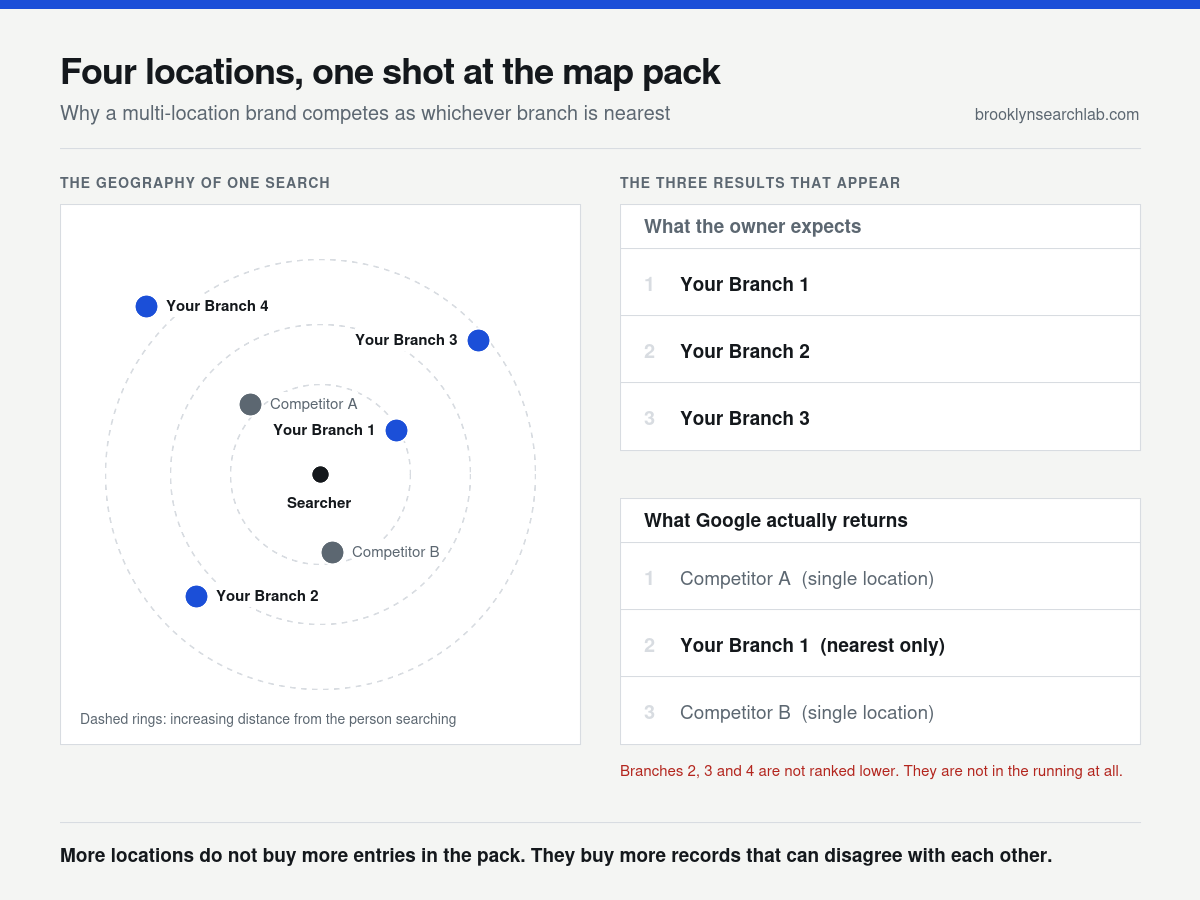
Owners tend to read a six-location footprint as six entries in the draw. It is not. It is one entry per search, chosen by geography rather than by which of your locations is strongest, and it is common for the nearest branch to be the newest, the thinnest and the one with nine reviews.
There is a second effect on top of that. Google will generally not show two profiles from the same business in one pack, which is consistent with everything visible in local results even though it is not documented as a named feature. Assume it holds, because the alternative, hoping to occupy two of three slots, has no evidence behind it and one very real cost: it is the reasoning that talks businesses into creating extra profiles they cannot defend.
Two profiles for one address is not a hedge, it is a violation. Duplicate listings get merged or suspended, and the recovery costs far more than the extra listing could ever have returned. Additional practitioner or department profiles are permitted only under narrow conditions, and a second front desk is not one of them.
The seven signals a single-location shop wins by default
Once the field is cut to your nearest branch against their only branch, the comparison is no longer between a large business and a small one. It is between two locations, and the small one is usually better specified.
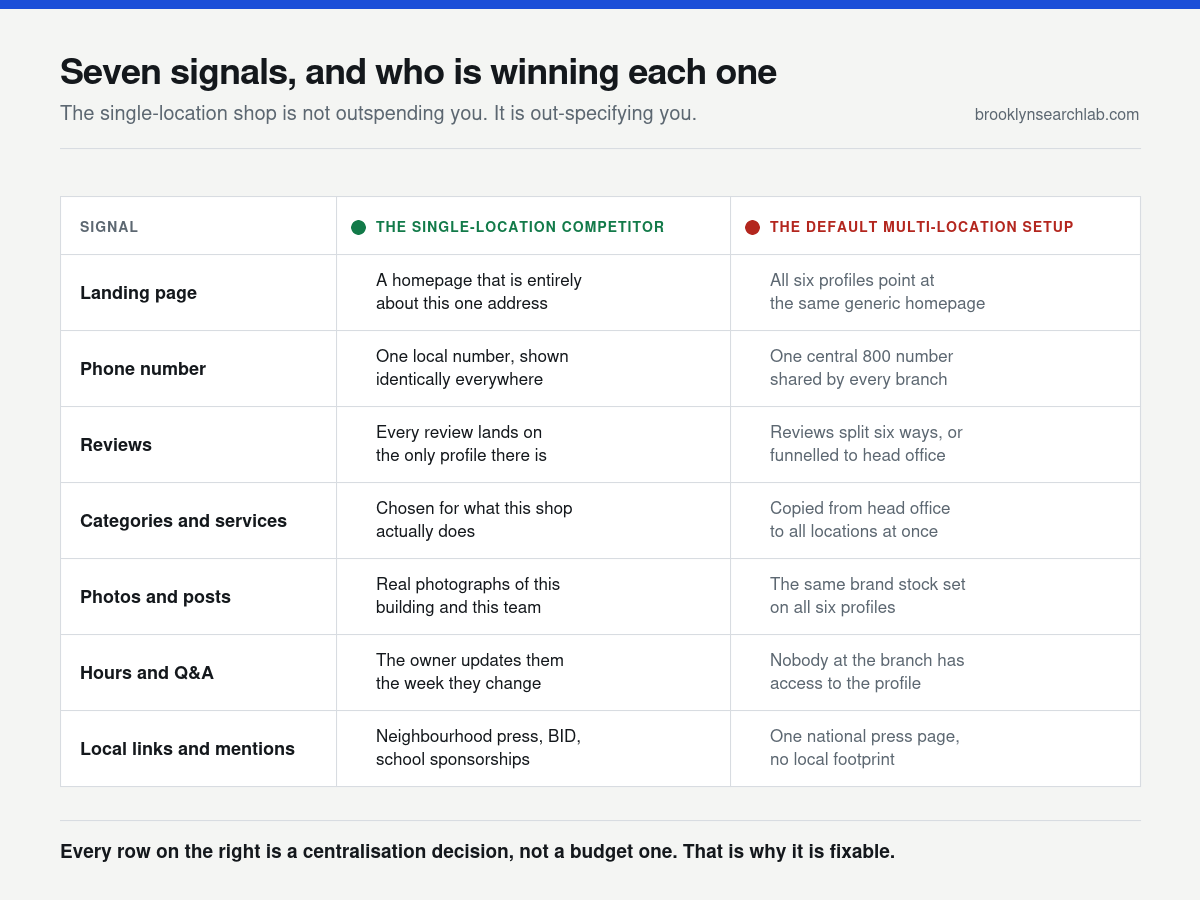
Read the right-hand column as a list of decisions rather than a list of failures. Nobody chose to weaken the Sunset Park branch. Somebody chose one phone system, one website template and one set of profile fields, which is the correct decision for almost every other part of the business and the wrong one here.
Why New York compresses all of this
Density changes the arithmetic in three specific ways.
Your locations sit close enough to compete with each other. In most of the country a second branch is fifteen miles away and serves an unrelated set of searches. In Brooklyn it might be a mile and a half, which puts both profiles inside the same radius for a meaningful share of searches while only one of them can appear. The overlap is not additive, and we walked through why proximity dominates this way in why a profile can rank first in Brooklyn and vanish in Manhattan.
The competitive set is denser than the pack. Three slots are allocated in categories where dozens of qualified businesses sit within a mile, so the cuts made before prominence is even applied do most of the work, as we covered in the map pack ranking factors nobody tells small business owners about. A centrally managed profile that is slightly wrong on category or hours does not lose narrowly here. It fails a filter.
Addresses are hostile to standardisation. Suite numbers, abbreviations and overlapping neighbourhood names multiply with every location you add, and a template that writes each branch address the same way is a template that writes several of them incorrectly. Google’s documentation on managing your business address is worth reading before a bulk edit rather than after one, and the propagation problem behind it is the subject of which directories still matter for NYC businesses.
What you can actually control
1. One landing page per location, and make it about the location
Six profiles pointing at one homepage is the most common defect we find, and the easiest to fix. Each profile should link to a page about that address: its staff, its hours, its parking, its neighbourhood, its reviews, its photographs. A page that differs from its siblings only by the place name in the H1 is a template, and it will be read as one.
Mark each page up as a location with LocalBusiness structured data, and use branchOf to state the relationship to the parent organisation explicitly rather than leaving it to be inferred. This is the same discipline that makes location pages work as an architecture instead of as duplicate content.
2. A real phone number for each address
A central number is defensible operationally and expensive locally. Where you can, give each profile a local line that matches the number on its landing page and in its directory records. Where the call centre is genuinely the only route, keep the primary number consistent everywhere and never let two locations publish different variants of the same number, which is the NAP consistency problem multiplied by the number of branches you operate.
3. Reviews that land on the branch that earned them
Review count and rating are per profile, so a chain that routes every request through one central link is building one strong profile and five weak ones. The request has to carry the branch’s own review link, which means the routing logic lives in whatever system knows which location did the work, and that is a job for workflow automation rather than for a manager remembering. On how many you need at each location, the honest answer is a benchmark rather than a number, which we worked through in how many Google reviews it takes to rank in NYC.
4. Categories and services set per location
The primary category is the heaviest single field on a profile, and it is the one most often copied across all locations from a spreadsheet. If your Bay Ridge branch does commercial work and your Bushwick branch is mostly residential, they should not be describing themselves identically. Set the primary category for what each location actually does most, and let the service list differ where the service list genuinely differs.
5. Access for the person who is physically there
Hours change, a photograph gets taken, a customer asks a question. If the only accounts with edit rights sit at head office, all three of those things happen late or not at all. Add the site manager as a user on their own profile. It is a permissions change, it costs nothing, and it is worth more than most of what gets bought instead.
6. Local links and mentions, per neighbourhood
This is the signal head office cannot buy centrally, and the one single-location competitors accumulate simply by existing. A sponsorship, a chamber listing, a local press mention, a neighbourhood association page. Each of those attaches to one address. A national press page attaches to none of them.
The org chart is the ranking factor
The strategic point underneath all six items is that none of them are marketing decisions. They are operational ones, made years earlier by people who were solving a different problem correctly.
One phone system is cheaper to run. One website template is cheaper to maintain. One set of profile fields is faster to update. Every one of those choices is right for the business and wrong for the index, and no amount of local SEO spend reverses a structural decision. It is why multi-location work so often stalls: the agency optimises fields while the organisation keeps overwriting them, and neither side has framed the problem as a systems problem.
It is also why the fix is usually cheaper than the campaign it replaces. Splitting a review request flow by location, generating genuinely distinct location pages from real per-branch data, and giving branch managers scoped access are engineering tasks with an end state, not a retainer. That combination of search work and build work is the reason Google Business Profile optimization sits next to software here rather than in a separate department, and it is the practical difference between SEO in Brooklyn, where proximity is winnable, and SEO in Manhattan, where the same brand usually has to win organically instead.
Key takeaways
- The location is the unit of competition, not the brand. Six profiles is not six chances, it is one chance per search.
- Only the nearest branch is evaluated. It is frequently your weakest one, and nothing about the other five compensates.
- Never create a duplicate profile to occupy a second slot. Merges and suspensions cost more than the slot was ever worth.
- The default centralised setup loses seven signals at once. Landing page, phone, reviews, categories, photos, access and local links.
- New York shortens the distances until your own locations start absorbing each other’s searches.
- The cause is the org chart. Centralisation is right for operations and wrong for a per-location index.
What to do this week
- Run the two-stop test. Search your category from outside two of your locations and record which profile appears. You are looking for the branch that never shows.
- List the landing page URL for every profile. If two of them are the same URL, that is your first fix, and it is a content problem rather than a profile problem.
- Compare primary categories across all locations. Identical everywhere usually means copied, not chosen.
- Pull review counts per location. A ten-to-one spread across branches tells you exactly where your request flow is pointing.
- Check who has edit access on each profile. Add the person who is physically at that address.
- Search each branch address in quotes. Duplicate or unverified profiles for an address you own need resolving before anything else is worth doing, and verification is the gate on all of it.
Common questions
Should I open more locations to rank in more neighbourhoods?
Only if the location is a real, staffed premises you would open anyway. A profile at an address you cannot defend is a suspension waiting to happen, and it puts the profiles you legitimately hold at risk during the review.
Can two of my locations appear in the same map pack?
Assume not. Plan on winning one slot per search from the nearest branch, and treat anything beyond that as a bonus rather than as a strategy.
My locations are close together. Are they cannibalising each other?
Not in the way keywords cannibalise. They are not splitting authority, they are splitting attention: each search resolves to one of them, and distance decides which. The risk is that you fund a shared programme and it only ever benefits whichever branch happens to sit nearest your customers.
What if we operate as a service area business from some sites?
Then the address handling and the ranking geometry both change, and mixing the two models across a group is where most of the confusion starts. Read how service area and storefront setup differ before standardising anything across the group.
Is a store locator page enough?
No. A locator is a navigation element. It is not a set of pages Google can rank, and a locator that renders its addresses in JavaScript may not be delivering them to the index at all.
How long does it take to see movement?
Landing page and category changes tend to show within weeks. Reviews and local links are cumulative and behave like the compounding assets they are, which is to say the branch you start today will trail the branch you started six months ago for a long time.
Find out which of your locations is actually invisible
The free audit maps every profile you hold against the searches it should be winning: which branches never enter a pack, where your own locations overlap, and which of the seven signals is costing you most at each address. Five business days, no obligation.
Related: Google Business Profile optimization, areas we serve, who we are.