
Here is a check that takes ninety seconds. Open your Google Business Profile and read the name field exactly as it is written. If your name appears twice in it, once in English and once in Chinese, Russian, Korean, Spanish, Hebrew or Arabic, that profile has been out of guideline since 10 August 2026. Nobody emailed you. There was no notification in the dashboard, and for most businesses nothing happened on the day.
What happens instead is that six or eight weeks later the phone is quieter, and the owner is certain a competitor bought their way past them. The name never comes up. It is the one field on the profile that nobody thinks of as a ranking asset, because it does not look like marketing. It looks like the sign over the door.
First, make sure you actually dropped
Two different things happened to New York local results this year, and from inside a business they feel identical. One is a genuine loss of position. The other is that the result format changed around you: for a growing share of mobile searches Google now assembles a shorter, AI-generated local answer that surfaces fewer businesses than the classic three-pack, and paid local units have taken more of the space above it. A business that still ranks exactly where it did can appear in fewer results than last year without having moved at all.
The two have opposite fixes, so separate them before you touch anything. Search your main category from a phone at your own address and note whether you are looking at a normal three-business pack or a compressed AI answer. Then run the same query from several points around your trade area rather than from your desk, because a single search from one spot tells you almost nothing. If the pack still has three businesses in it and you are no longer one of them, that is a ranking change, and the factors that actually decide map pack position are where to look. If the pack itself has shrunk, you are looking at a format change, and no amount of profile work will put the third slot back.
The rule that changed on 10 August 2026
Google’s guidelines for representing your business on Google have always restricted what may appear in the name field: no taglines, no store codes, no phone numbers, no service descriptions, no location qualifiers. In August a new prohibition joined that list. You may not repeat the same business name in multiple scripts or languages, and the guideline states the point explicitly, even if it appears that way on physical storefront signage.
That last clause is the whole story. Signage was the argument that used to win. When a profile was flagged for a dual-script name, the owner submitted a photograph of the storefront, the name on the sign matched the name on the profile, and the appeal succeeded because the guideline had always deferred to the real-world name. That defence is now closed. The sign can say both. The profile may say only one.
Google’s published examples pair a Latin name with a Japanese one, but the rule is script-agnostic. A Brooklyn bakery listed as Malina Bakery / Малина Пекарня is in exactly the same position as the Tokyo example, and so is every Flushing restaurant carrying its name in Hanzi alongside the English.
The name field was doing ranking work
Google describes local results as ordered by relevance, distance and prominence. Distance you cannot change. Prominence accrues slowly, through reviews, links and mentions. Relevance is the one input where a single field you control is read directly against the words a customer typed, and the name is that field.
This is why the change is not cosmetic. A dual-script name was not keyword stuffing. For a shop whose customers are Russian-speaking, the Cyrillic half of the name is the name, and it is the string those customers type into a phone. Removing it does not make the profile tidier. It removes an entire class of query the profile used to answer exactly.
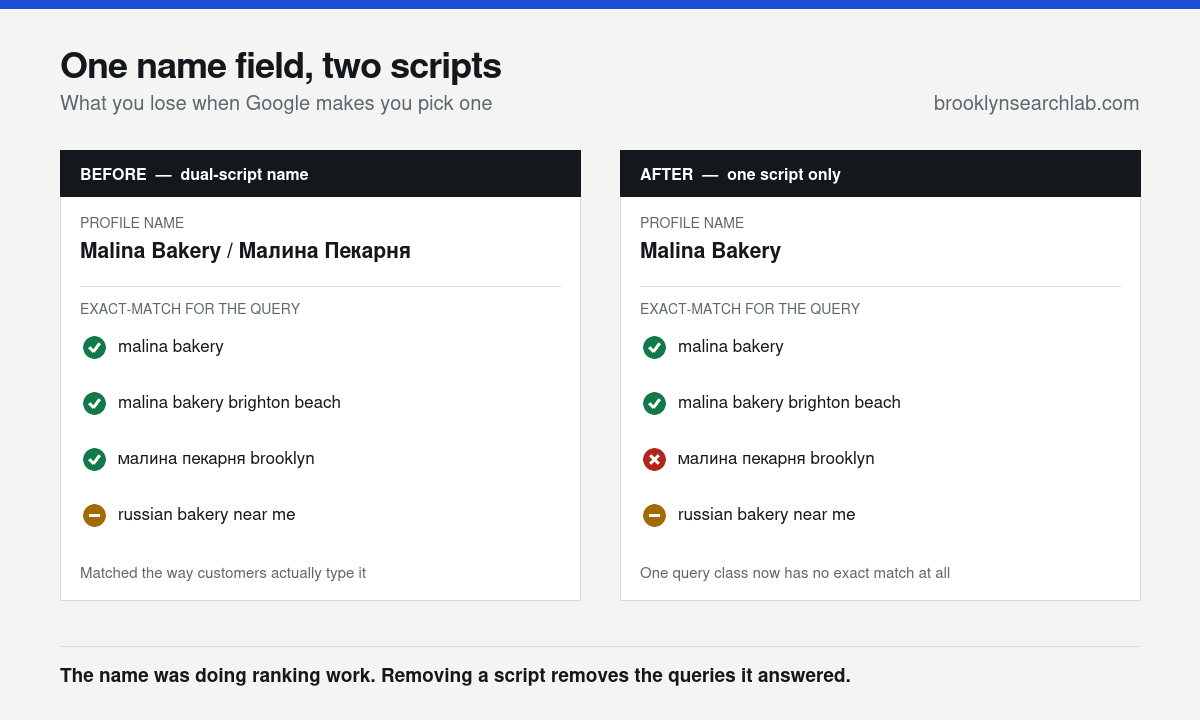
The English queries survive. The second-language queries lose their anchor, and they lose it at the moment they are most valuable, because those are the searches with the least competition and the highest intent in the whole category.
Why this lands hardest in New York
Roughly half of New York City residents aged five and over speak a language other than English at home, according to Census Bureau QuickFacts. That is not a niche. In Brighton Beach, Sunset Park, Flushing, Jackson Heights, Borough Park and Bay Ridge, a storefront carrying its name in two scripts is the ordinary case rather than the clever one, and the second script is on the awning because that is what the neighbourhood reads.
So a guideline written to stop keyword padding lands, in this city, on thousands of businesses that were describing themselves accurately. The exposure is heaviest exactly where local search is otherwise most winnable: dense, walk-in, category-competitive blocks where the map pack decides the day’s revenue and where SEO in Brooklyn is fought on proximity and profile quality rather than on domain strength. It is much lighter in Midtown, where the same businesses compete organically instead, which is one more reason SEO in Manhattan and the borough where your pin actually sits are genuinely different problems.
What actually breaks when you edit the name
You lose a query class, not just some characters
This is the loss you can measure and the one nobody forecasts. Before editing, write down the second-language searches the profile currently wins. You will want that list, because rebuilding coverage for those queries is the actual work that follows.
The edit re-opens the profile for review
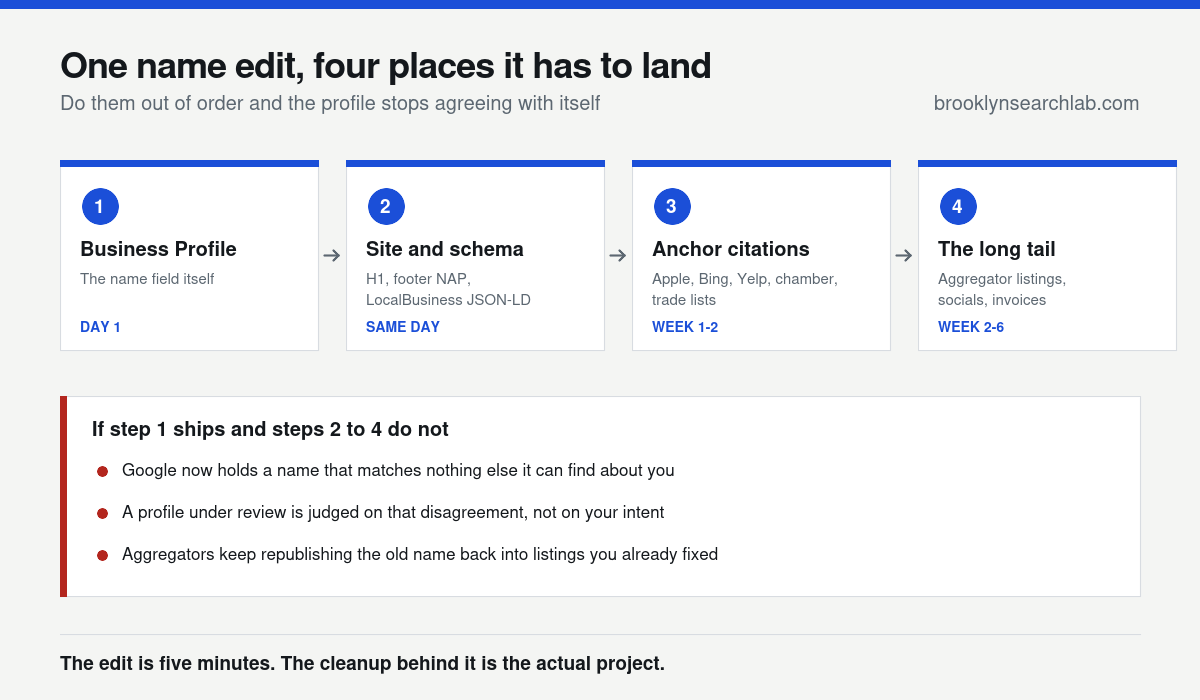
Name changes are among the edits most likely to trigger a re-review, and a profile in review is judged on whether its name agrees with everything else Google can find about the business. If the rest of your footprint still carries the old dual-script name, the edit that was meant to bring you into compliance is what makes you look inconsistent. Google’s guidance on suspended and disabled profiles is worth reading before you submit the change rather than after.
Your citations immediately disagree with you
Every directory, aggregator and chamber listing still holds the old string. That is the definition of a NAP inconsistency, and the aggregators that feed each other will keep republishing the old name into listings you have already corrected unless you fix them at the source. Which listings are worth the effort is a shorter list than most agencies suggest, and the directories that still matter for NYC businesses is where to start.
Your own site still says the old name
The footer, the contact page and the LocalBusiness structured data on your site are the most authoritative statement of your name that you control outright. If the profile changes and the markup does not, you have introduced a contradiction in the one place Google trusts most.
What you can control
Choose the name on the door, in one script
Pick the version a stranger would use to refer to you out loud, and make it the version on the profile, the site, the invoices and the listings. If your customer base is majority second-language, that version may well be the non-English one. There is no rule that the surviving script has to be English, only that there is one of them.
Move the second script to fields that still allow it
The name field is closed. The business description is not, and neither are Posts, Q&A, the photo of your storefront sign with both scripts on it, or the language your customers write reviews in. A profile carrying a Russian description, Russian-language Posts and forty reviews written in Russian is still unmistakably a Russian-speaking business to a system that reads meaning rather than matching strings, and review volume and recency are doing more of that work every year.
Rebuild the coverage on pages you own
The queries the name field used to answer can be answered by a page instead, and a page cannot be taken away by a guideline change. A genuine second-language page on your own domain, indexed and internally linked rather than machine-translated boilerplate, is the durable version of what the name field was doing for free. That is ordinary technical and content SEO work applied to a problem most owners would not think to bring to it.
Google is deduplicating strings, not meanings
It is worth being clear about what this rule is and is not. It is a data-hygiene decision. A name repeated in two scripts is one business represented as two strings, and an index that has spent a decade moving from keyword matching towards entity understanding does not need the second string to know what you are. The rule is Google removing a redundancy it believes it no longer depends on.
Whether that belief is correct for your business is an empirical question, and the honest answer is that it depends on how much else you have. If the second script in the name field was the only signal tying you to a second-language audience, the rule takes a real asset away and you will feel it. If that association also lives in your reviews, your description, your photos, your posts and a page on your own domain, Google has several independent ways to reach the same conclusion and losing the name string costs you very little.
Which means the businesses hurt worst by this change are the ones whose local presence was thinnest to begin with, and the fix is the same fix as always: stop relying on one field. That is the argument for treating Google Business Profile work as an ongoing programme rather than a setup task, and it applies to every neighbourhood we work in across Brooklyn.
Key takeaways
- Since 10 August 2026 Google prohibits repeating a business name in multiple scripts or languages, and storefront signage is explicitly no longer a defence.
- Before you fix anything, establish whether you lost position or whether the result format shrank around you. The remedies are unrelated.
- The name field feeds relevance directly, so removing a script removes an entire class of query the profile answered exactly.
- Around half of New Yorkers speak a language other than English at home, which is why a global hygiene rule behaves like a local one here.
- The edit takes five minutes. Bringing your site, schema and citations into agreement with it is the actual project, and skipping it is what turns a compliance fix into a suspension risk.
- Rebuild the lost coverage in fields and pages you own, where no future guideline change can reach it.
What to do this week
- Read your name field literally. If the same name appears in two scripts, you are affected, whether or not anything has been flagged.
- Record what you are about to lose. Note the second-language searches you currently win, so you can measure the gap afterwards instead of guessing at it.
- Decide which single version is the real name, and confirm it is the one on your door, your invoices and your site. It does not have to be the English one.
- Change the site and the structured data the same day you change the profile, not the week after.
- Fix the anchor citations next, starting with the aggregators that feed the smaller directories rather than the smaller directories themselves.
- Put the second script back everywhere it is still permitted — description, Posts, Q&A, a photo of the sign — and start asking second-language customers for reviews in their own language.
Common questions
Will Google suspend me if I do nothing?
Not automatically, and most non-compliant profiles are still running. The realistic risk is a competitor report or a routine re-review, at which point the name is corrected for you, often alongside other edits you did not ask for. Choosing your own name is better than having one chosen.
Can I keep both scripts if the second one is legally registered?
The guideline is about repeating the same name, not about which language it is in. A genuinely different registered legal entity name is a different question, but a transliteration or translation of the same name is exactly what the rule now covers.
What if my sign really does have both?
It can. The guideline addresses the profile, not the storefront, and it says directly that signage does not justify the repetition. Photograph the sign and upload it — the second script is still visible to customers on the profile, just not in the name field.
Should I choose the English name or the other one?
Choose the one more of your customers actually say. If most of your walk-ins ask for you by the non-English name, that is your name, and picking English for tidiness costs you the searches that were converting.
How long until rankings recover?
English-language positions usually hold throughout, because nothing about them changed. Coverage for second-language queries recovers as the replacement signals accumulate, which is a matter of months rather than weeks, and it recovers faster where reviews and description work started before the name edit rather than after it.
Does this affect service area businesses too?
Yes, identically. The name rule is not tied to whether you have a storefront, though the rest of the setup does differ — service area and storefront profiles are configured differently in ways that matter more than most owners realise.
Find out what the name change is costing you
The free audit checks your profile against the current name guidelines, maps which second-language searches you are winning today, and lists every citation still carrying the old string in the order worth fixing them. Five business days, no obligation.
Related: Google Business Profile optimization, areas we serve, who we are.