
We built the Manhattan page on this site around a keyword almost nobody types. The original plan named manhattan seo as the highest-value target we had. When we re-pulled current Google Ads data for the New York metro this month, that phrase returned ten searches a month. Ten. In the same pull, seo agency nyc returned 590 and nyc seo returned 480, and neither of them contains the word Manhattan at all.
That gap is not a rounding error in a keyword tool. It is the most useful thing we know about selling services in this city, and it explains a failure pattern we see constantly: a business does the local SEO work that made it visible in Brooklyn, repeats it for Manhattan, and gets nothing back. The work was not lazy. It was aimed at the wrong half of Google.
What the search data actually says
These are average monthly search volumes from Google Ads for the New York, NY market, covering the twelve months to July 2026. The grouping is the whole argument.
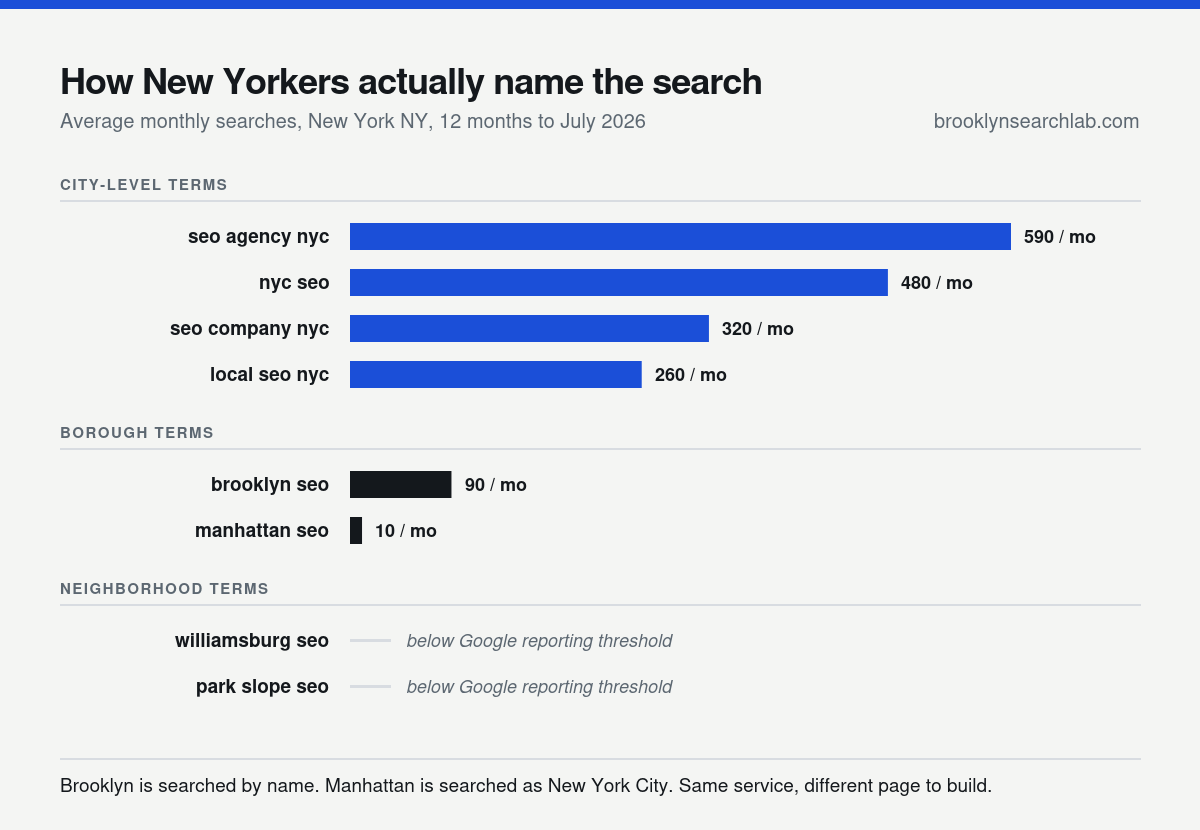
Three things fall out of it. City-level phrasing carries roughly ten times the volume of any borough phrasing. The Brooklyn modifier is real but small. The Manhattan modifier is, for practical purposes, not there. And neighborhood terms, the ones agencies most love to sell as a page each, sit below the threshold Google will report a number for.
One honest caveat before anyone builds a quarter on this: Keyword Planner rounds aggressively at the low end and suppresses terms below a floor, so a reported 10 means “very few” rather than exactly ten, and an unreported term means “fewer still” rather than zero. That imprecision does not rescue manhattan seo. A term Google will not report a real number for cannot carry a page that took three weeks to build.
Brooklyn is a name. Manhattan is the default.
The reason is not a quirk of the data. It is how people in this city talk. Brooklyn is an identity, so the word does real work in a search: someone typing brooklyn seo is deliberately narrowing, ruling out the Midtown firms and the price that comes with them. The borough name is a filter they are choosing to apply.
Manhattan is the unmarked case. When a business below 96th Street looks for a vendor, it does not think of itself as searching inside a borough, because in the vocabulary of the search, New York City already means Manhattan. So the query comes out as nyc seo, or seo agency nyc, or seo company nyc. The borough is implied by the whole city’s name, and adding it explicitly would feel redundant to the person typing.
This has a direct consequence for how the two location pages on a site have to be written. A page aimed at SEO for Brooklyn businesses can lead with the borough, because the borough is the query. A page aimed at SEO for Manhattan businesses has to be built to win city-level terms while still reading as a Manhattan page to the human who lands on it. Same site, two genuinely different documents.
The neighborhood row is worth sitting with. williamsburg seo and park slope seo return no measurable volume, and they are two of the most search-visible neighborhood names in the country. If those two have nothing, Gowanus and Homecrest have less. Neighborhood-level relevance in Brooklyn is real, but it does not arrive through neighborhood keywords. It arrives through proximity in the map pack, which is a completely different mechanism and needs completely different work.
The two boroughs are decided by different parts of Google
Google is explicit that local results are ordered by relevance, distance and prominence. Distance is a first-class input there, and it is the one you cannot influence, because it is the straight-line gap between your verified pin and wherever the searcher is standing.
Organic results are assembled differently. Google’s own account of how Search works describes ranking against the meaning and quality of pages, with location used as context rather than as a distance measurement to a business address. Organic results for a query like seo agency nyc still get localized to the city, but they are not sorted by how many miles your office sits from the person searching. That single difference is what splits the two boroughs into two different projects.
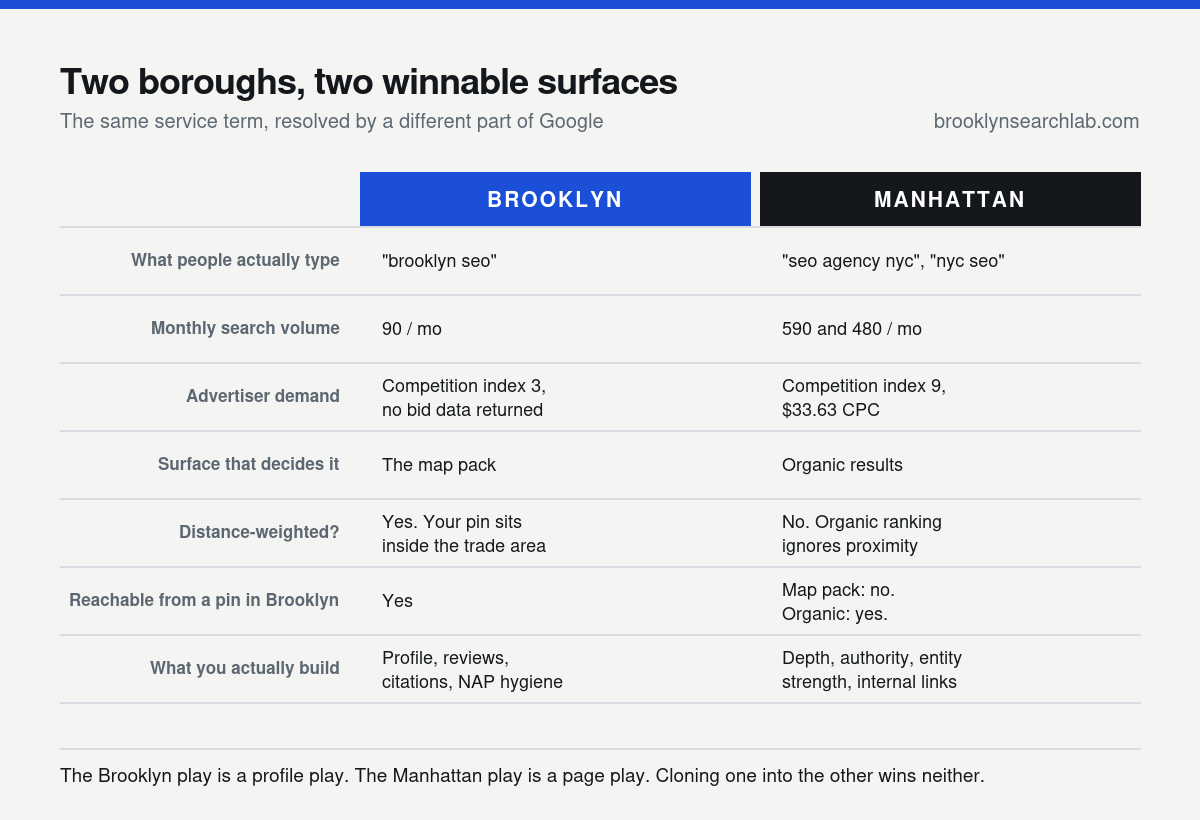
Read the last row first. From a pin in Brooklyn, the Manhattan map pack is not a slow project. It is not available. The organic result for the same customer is entirely available, and it is where the volume was sitting the whole time.
Why Manhattan’s density makes the pack unreachable, not just hard
The 2020 census counted 1,694,251 people in Manhattan and 2,736,074 in Brooklyn, per the Department of City Planning’s census briefing. Brooklyn holds a million more people, which is the number everyone quotes. The number that matters here is the land underneath them: Manhattan fits its 1.69 million into roughly 23 square miles, while Brooklyn spreads 2.74 million across about 70.
Density is what decides how far a map pack has to reach. When a searcher in Midtown asks for a service, Google can fill three slots from businesses within a few blocks, so it does. The effective radius collapses. In much of Brooklyn the same query has to reach a mile or two before three qualified businesses exist, which is precisely why a well-optimized profile in Homecrest or Bay Ridge shows up across a meaningful area. We wrote this up in more detail when a client’s profile was ranking first in Brooklyn and vanishing in Manhattan, and nothing about the mechanism has changed since.
The common workaround does not work. Adding Manhattan to your service areas tells Google where you are willing to travel. It does not move your pin, and it does not enter the distance calculation for a searcher standing in Union Square. A service area is a statement about delivery, not about proximity, and treating it as a ranking lever is the single most common wasted afternoon in local SEO.
What the Brooklyn play actually is
Brooklyn is winnable in the pack, which means the profile outranks the website in importance. That inverts the usual order of work.
The profile is the product
Category, hours, primary services, photos and the name field carry more weight here than another 800 words on a service page. Get the profile complete and accurate before touching content, and know which of the factors that actually decide map pack position you have left blank.
Reviews benchmarked to the neighborhood, not the city
The number you need is set by whoever currently holds the three slots for your query in your part of Brooklyn, not by a national average. In practice that means the review count that ranks in NYC varies wildly by a few miles, and the honest answer is always a count relative to the incumbents.
The boring consistency work
Name, address and phone agreement across the aggregators is unglamorous and it moves pack position, which is why NAP consistency keeps outperforming the tactics people would rather buy. The same is true of the directories that still matter for NYC businesses, where a short list of anchors beats a long list of filler.
Pages that support the profile
Your Brooklyn service pages exist to give Google a consistent, corroborating account of the same entity. That is a supporting role, and it is the reason Google Business Profile optimization and page work belong in one plan rather than two.
What the Manhattan play actually is
Manhattan is an organic project from the first day, and the work looks almost nothing like the above.
Target the city term, describe the borough
The page has to be built to rank for the phrasing people use, which is city-level, while still reading as a Manhattan document to the person who lands on it. Those are not in conflict. A page can open on the Midtown and Flatiron problems it solves and still be structured around the term that carries 590 searches a month.
Depth instead of coverage
In the pack, more locations is a strategy. In organic, more thin pages is a liability. One page that genuinely answers what a Manhattan B2B buyer needs to know outperforms nine near-identical neighborhood pages, which in practice compete with each other until Google picks one canonical from the cluster, and it is rarely the one you wrote. The same logic governs how we scope SEO engagements generally: fewer pages, each of them load-bearing.
Entity strength, since proximity is off the table
With distance removed as an input, what is left is whether Google is confident about who you are. That is LocalBusiness structured data that agrees with your profile and your citations, a consistent entity across the site, and links from places that would plausibly mention a firm like yours. Slow, and the only thing that compounds.
Say the quiet part on the page
Our own Manhattan page states that we are not chasing the Manhattan map pack from a Brooklyn address, and why. It costs nothing, since the pack was never available, and it separates you from every competitor promising map pack results they cannot deliver from an outer-borough pin.
The clone page is the trap
Here is what usually happens instead. The Brooklyn page works, so someone copies it, replaces every instance of Brooklyn with Manhattan, and publishes. Then they do it again for Queens, and the Bronx, and Staten Island.
Two things go wrong at once. The clone is optimized for a term with almost no volume, so even a first-place ranking returns nothing, and this is the part that is genuinely hard to see, because Search Console will happily report impressions and an average position that look like progress. The second problem is structural: a set of pages that differ only by a place name is close to the definition of what Google’s guidance on helpful, people-first content tells you not to build, and it drags on the pages around it.
The alternative is one entity making two arguments. The Brooklyn side argues proximity and presence and is measured in pack position. The Manhattan side argues expertise and fit and is measured in organic position for city terms. They share a business, an address and a schema graph. They do not share a template, a keyword, or a definition of success.
Key takeaways
- In the New York market, manhattan seo draws about 10 searches a month while seo agency nyc draws 590. The borough modifier works in Brooklyn and effectively does not exist in Manhattan.
- Brooklyn is a chosen filter; Manhattan is the default that the city’s own name already covers. That is a fact about how people speak, not about Google.
- Local results are weighted by distance. Organic results are not. Brooklyn is therefore a map pack project and Manhattan is an organic project, from day one.
- Manhattan’s density collapses the pack radius to a few blocks, so from an outer-borough pin the Manhattan pack is unavailable rather than merely competitive. Service area settings do not change this.
- Neighborhood keywords have no measurable volume even in Williamsburg and Park Slope. Neighborhood relevance comes from proximity, not from a page per neighborhood.
- Cloning the Brooklyn page for every borough targets terms nobody searches and builds exactly the near-duplicate set Google’s content guidance warns against.
What to do this week
- Pull current volumes for your own service terms, borough and city versions side by side, in the New York market rather than nationally. Do not reuse a number from a plan written last year.
- Check which surface your money query returns. Search it from a phone in the neighborhood you actually want customers from, and note whether you are looking at a map pack or ten organic results. That single observation decides the whole plan.
- Separate your two scoreboards. Track pack position for Brooklyn terms and organic position for city terms. Averaging them together hides both.
- Audit your Manhattan page for the clone smell. If find-and-replace on one place name would turn it into your Brooklyn page, it is not a Manhattan page.
- Rewrite the Manhattan page around the city term, keeping the borough language for the reader and the section headings, not for the ranking target.
- Put your neighborhood effort into the profile, not into a page per neighborhood. Reviews, categories and consistency buy the coverage that neighborhood pages were never going to.
Common questions
Should I delete my Manhattan page?
Almost never. It should be rewritten rather than removed, because a genuinely useful Manhattan page can rank for city-level terms and convert the reader who arrives with a borough in mind. What should go is the assumption that its keyword is the borough name.
Does this mean borough pages are a waste of time?
No, and Brooklyn is the proof. The rule is that a borough page has to earn its keyword. Brooklyn has one, Queens and the Bronx have thinner ones, and Manhattan’s is effectively absorbed by the city name. Build to the demand that exists in each case rather than to a template of five identical pages.
Can I rank in the Manhattan map pack if I open a small office there?
A genuine, staffed location that meets Google’s guidelines can rank there, and in a borough that dense the radius it reaches will be small. A mailbox or a coworking desk used only for a listing is a suspension risk rather than a strategy, and it is the fastest way to lose the profile that was already working.
What about Queens, the Bronx and Staten Island?
They behave more like Brooklyn than like Manhattan: the borough name is a real filter people apply, the volumes are smaller, and proximity still decides the pack. The difference is that the volume is thin enough that a page should not go up until you can write 300 genuinely distinct words about working there.
How long before the Manhattan approach shows anything?
Organic position for competitive city terms moves in quarters, not weeks, which is exactly why the pack felt more attractive. The compensation is that pack position can be taken from you by someone opening closer to your customer, and an organic position built on depth and entity strength cannot.
Is the same split true for web design and development work?
Yes, and the numbers run the same way: nyc web design draws about 480 searches a month against 50 for brooklyn web design and 10 for the Manhattan version. Any service where the buyer might be anywhere in the city behaves this way, which is why our web design pages are structured on the same principle.
Find out which surface your money queries actually return
The free audit pulls current New York volumes for your service terms, shows whether each one returns a map pack or organic results, and tells you which of your location pages is aimed at a keyword nobody types. Five business days, no obligation.
Related: SEO services, SEO in Manhattan, who we are.