
The most common thing we find on a stalled Google listing is not a missing factor. It is a primary category that somebody picked during sign-up four years ago, in a hurry, and nobody has looked at since. It quietly decides which searches the business is even eligible for, and nothing in Google’s interface tells you it is costing you anything.
Local SEO advice is unusually top-heavy. It concentrates on the last thing that happens, prominence, because that is the part that can be sold as an ongoing service. The cuts that happen before it get almost no attention, and those are the ones that decide whether you were ever in the running.
This is the list nobody hands a small business owner.
The three factors, and the sentence everyone stops reading before
Google’s local ranking guidance names three inputs: relevance, distance and prominence. Almost every article about the map pack quotes that line and then spends the rest of its length on prominence.
Relevance is defined as how well your profile matches what someone searched for, and Google’s own advice for improving it is to add complete and detailed business information. That is a category, services and attribute problem. It is largely solved in an afternoon and then left alone, which is exactly why so many listings are quietly failing it.
The map pack filters before it ranks
It helps to stop thinking of the pack as a leaderboard where everyone is scored and the top three win. It behaves much more like a series of cuts, and prominence is only applied to whatever survives them.
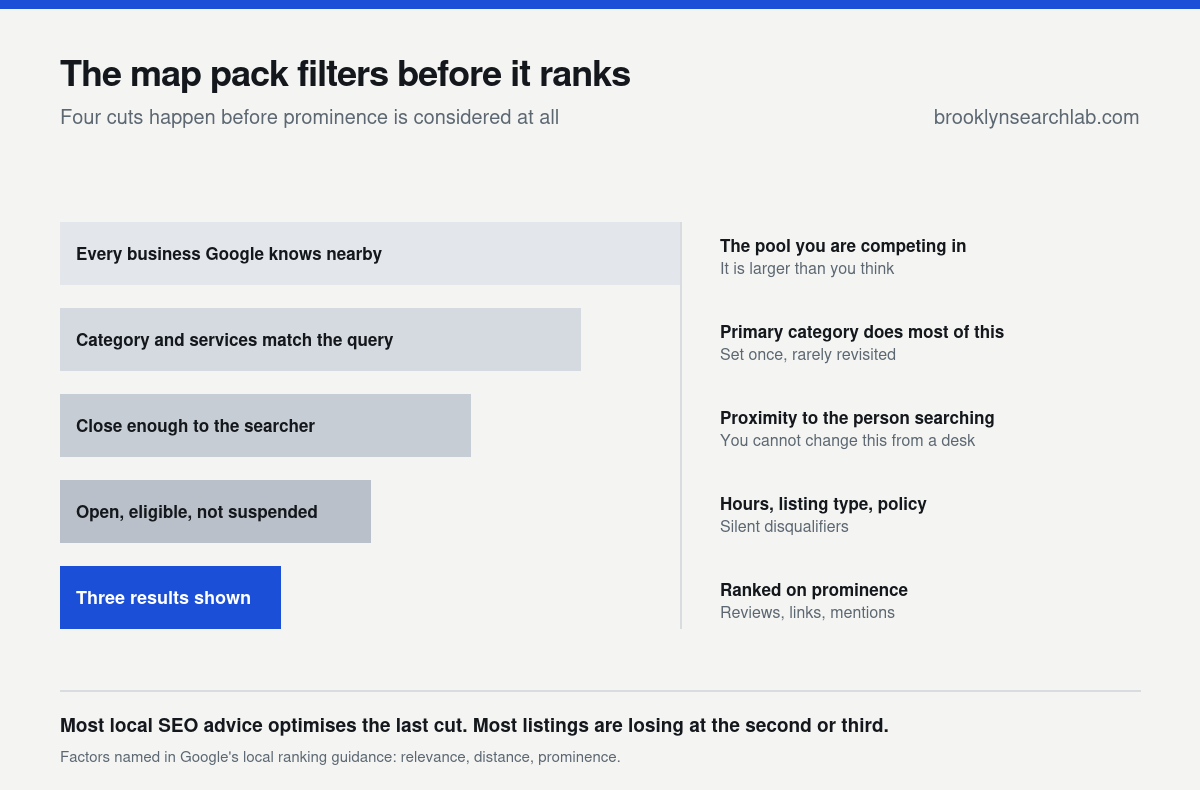
Read it from the top and the usual pattern of wasted effort becomes obvious. A business fails the category cut, then spends a year and a budget on reviews and citations, which only ever mattered at the bottom of the funnel. The work was competent. It was applied to a stage the listing never reached.
This is the diagnostic question worth asking before any local campaign starts. Not “how do we get more prominent”, but “which cut are we losing at”. The answer is usually visible in twenty minutes, and it changes what the next six months should cost.
Primary category is the highest-leverage field you own
Your profile can carry several categories, but they are not equal. The primary category does most of the work of deciding which queries you are a candidate for, and Google keeps the available list deliberately constrained, as its guidance on managing your business category describes.
Two consequences follow, and both are counterintuitive.
Broader is not better. A business that sets its primary category to something general, hoping to catch everything, often competes for nothing in particular. A tighter primary that matches the query you actually want tends to outperform the general one, because relevance is assessed against a specific search.
Your competitors publish their categories. The businesses currently occupying the pack you want are telling you which category Google considers correct for that query. That is not a guess, it is observable, and it is the fastest audit we run at the start of a Google Business Profile optimization engagement.
Secondary categories matter too, with a caveat. Adding categories you do not genuinely serve dilutes relevance and, in some categories, invites review. Add what you actually do.
The factors nobody sells you
These share a common shape. They are set once, they are invisible when wrong, and nobody can bill for them monthly.
The services list
Most profiles leave the services section empty or half-filled. It is a structured field that lets you state what you do in language Google can match against a query, and it is documented under managing your services. For a business whose category is broad but whose work is specific, this is the field that reconciles the two.
Hours, and especially special hours
Hours are a ranking-adjacent filter with a sharp edge. A great many local searches happen outside business hours, and a profile that is closed is competing differently to one that is open. Worse is the profile that claims to be open and is not. Public holidays are where this fails at scale, which is what special hours exist to prevent. A listing showing open on Thanksgiving collects a bad review from someone who drove there.
The listing type
Storefront or service area is not a cosmetic setting. It determines the point your distance is measured from, and getting it wrong is the most common cause of suspension we see. We wrote that up separately in storefront versus service area setup, and if you travel to customers, how you define service areas is part of the same decision.
The business name field
Your name field must be your real-world business name. Google’s guidelines for representing your business are explicit, and the reason this factor is worth naming is uncomfortable: stuffing keywords into the name field does appear to help, which is precisely why competitors do it, and why it is reportable and gets listings edited or suspended. Building a position on it means building on something a competitor can remove with a form.
What you are being sold instead
Not useless, mostly. Just wildly out of proportion to the attention it gets.
Weekly posts. Useful for conversion once someone is already looking at your profile. A thin lever on whether they see it at all.
Photo volume. A profile with no photos looks abandoned and converts badly. The difference between forty photos and four hundred is not where your problem is.
Bulk citation building. Consistency across the directories that matter is genuinely load-bearing, which is why we wrote about NAP consistency at length. A package promising three hundred citations is selling volume where the mechanism rewards accuracy.
Review totals as a scoreboard. Reviews do feed prominence, but when we counted what the businesses in the Brooklyn pack actually had, they held 51, 231 and 32 reviews, while the most-reviewed plumber in the area sat on 643 and was not shown at all.
Your rank is a surface, not a number
This is the factor that reframes everything above, and the one most reporting quietly hides.
There is no single map pack position for a local term, because the result changes with where the searcher is standing. Ask for “your ranking” and you will be given a number measured from one arbitrary point.
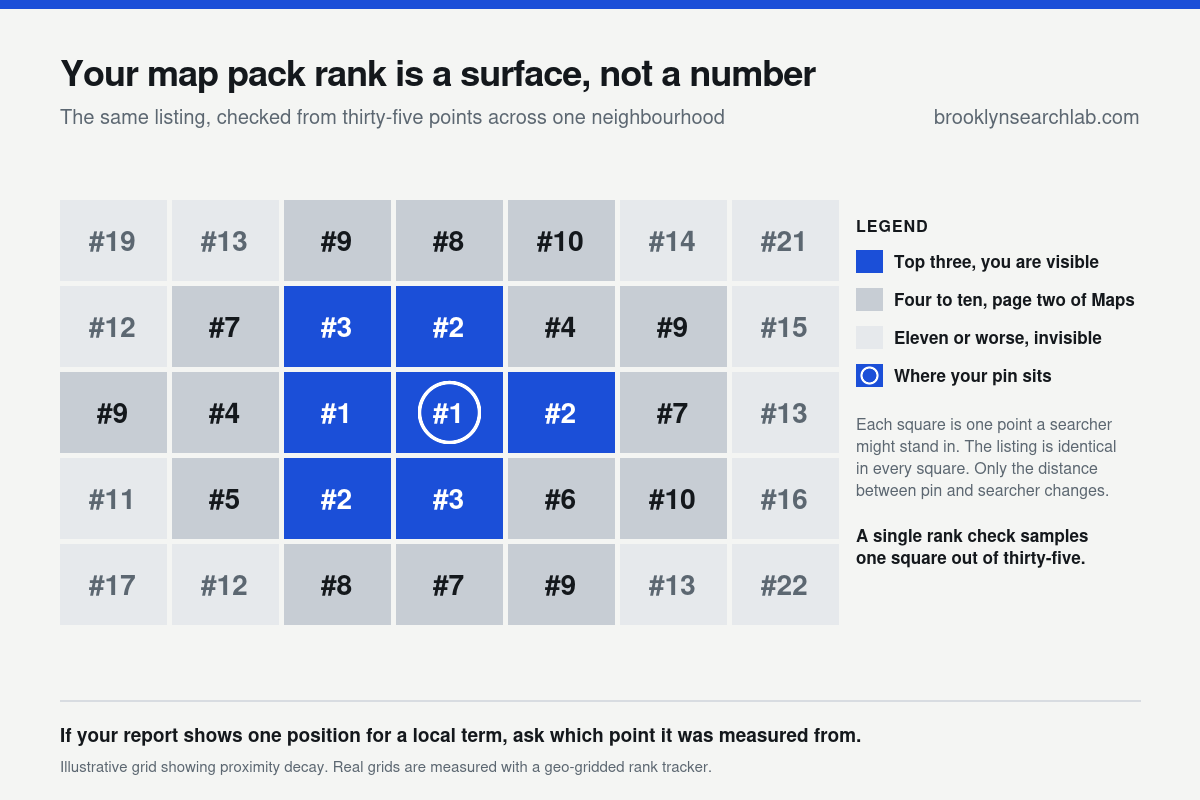
The same listing, unchanged, is first at the pin and fourteenth a mile away. Both numbers are true. Someone wanting to look good measures near your office; someone wanting to sell you a rescue package measures far from it. Neither number means much alone, which is why a geo-grid is the baseline artefact of a local engagement rather than a single tracked position.
It also explains the most common complaint we hear: that a business ranks well when the owner searches and never appears when customers do. Both observations are usually accurate.
Organic reporting hides the same illusion in a different place. Search Console averages position across every location and device that saw you, which is how a page holds position one in the report and appears nowhere in a real search.
What this looks like in New York specifically
Density makes every one of these sharper. In a borough where forty qualifying businesses sit within a mile, the distance cut does more work than it would almost anywhere else in the country, and the surface in that grid gets much steeper. A mile of separation in Brooklyn can be the difference between first and invisible.
It also means the honest answer for some searches is that the map pack is not available to you. Our own pin is in Homecrest, roughly ten miles from Midtown, so no amount of category tuning wins us a Midtown pack. That is why SEO in Brooklyn and SEO in Manhattan are built as different strategies rather than one plan run twice, and why the Manhattan work runs through organic location pages, where proximity does not apply. The underlying mechanism is in why a profile ranks in one borough and vanishes in another.
Key takeaways
- The pack filters before it ranks. Category, proximity and eligibility cut the field before prominence is applied.
- Primary category is the highest-leverage field on the profile, and a tighter one usually beats a broader one.
- Your competitors publish their categories. The pack you want is telling you which one Google thinks is correct.
- Services, hours and listing type are silent disqualifiers. Set once, invisible when wrong, unbillable monthly.
- Rank is a surface. A single position is one sample from a grid that runs from first to invisible.
- Density amplifies all of it. In New York the distance cut does more work than almost anywhere.
What to do this week
- Open your primary category and read it aloud. If it does not match the words a customer would type, that is your first cut, and nothing downstream matters yet.
- Study the pack you want. Look at the three businesses currently ranking and note what they appear to be categorised as. Match the pattern rather than guessing.
- Fill in the services section properly. Every service you actually offer, in the words customers use, not internal names.
- Add special hours for the next three public holidays. Ten minutes, and it prevents the review you cannot argue with.
- Check your rank from somewhere other than your office. Anywhere in the neighbourhood you actually want customers from. If the number collapses, you now know the shape of the problem, and whether it is a profile problem or a technical and organic SEO problem instead.
Common questions
How often should I change my primary category?
Rarely, and never casually. Change it when it is genuinely wrong, or when what the business does has shifted. Rotating it to chase different queries resets the relevance signal without ever establishing one.
Do secondary categories help or dilute?
They help when they describe work you really do, because they widen the set of queries you are a candidate for. They dilute when they are aspirational. The test is whether you could serve a customer who arrived through that category today.
Why does my business rank when I search but not when my customers do?
Because you are usually searching from your own premises, which is the most favourable point on the entire grid. Your customers are standing somewhere else. This is the most common false positive in local SEO.
Are Google Business Profile posts worth doing at all?
Yes, for conversion. Someone already looking at your profile is a warm audience, and a current post signals an active business. Just do not expect posts to move you into a pack you were filtered out of earlier.
My competitor has keywords stuffed into their business name. What can I do?
Report it through the profile itself, and be patient, because enforcement is uneven. What is not worth doing is matching them. It is a position built on something Google removes, and when the removal comes the rankings go with it.
How do I know whether the map pack is realistically reachable for me?
Look at where the current pack members sit relative to the area you want, and how far you are from it. If everyone ranking is clustered somewhere you are not, the pack is a distance problem, and no amount of profile work solves it. That is when the effort belongs on organic instead.
Find out which cut you are losing at
The free audit includes the local diagnostic described here: whether your category matches the queries you want, what the current pack members are doing differently, how your position varies across the neighbourhood, and whether the pack is reachable from your pin at all. Five business days, no obligation.
Related: Google Business Profile optimization, SEO in Brooklyn, who we are.