
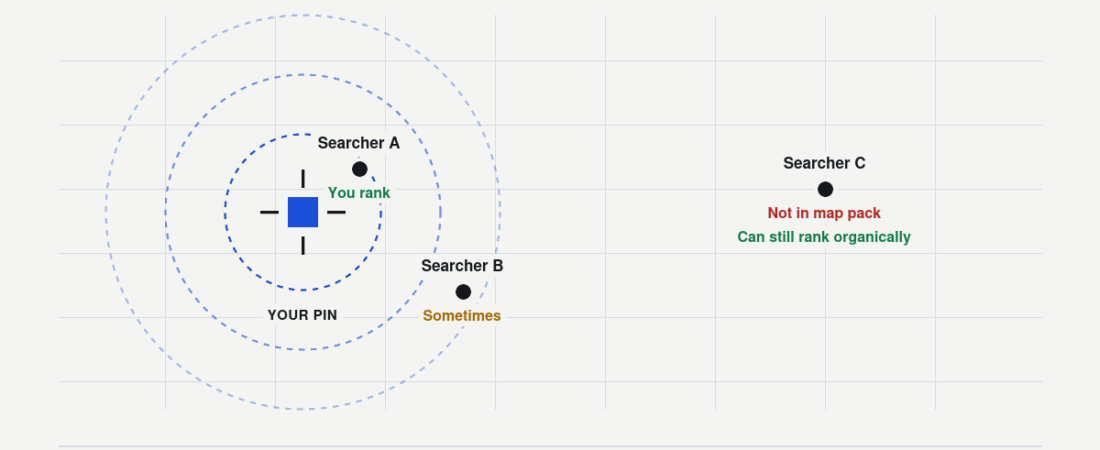
A Brooklyn contractor called us because his Google Business Profile ranked first for his category in Sheepshead Bay and could not be found at all from Midtown. Nothing had changed on the listing. Nothing was broken. The profile was working exactly as designed.
This is the single most common local search question we get, and almost every answer online gets it wrong. The usual advice is to add more keywords to your business description, post more often, or buy more citations. None of that addresses what is actually happening.
What is happening is distance. And distance is the one local ranking factor you cannot optimize your way around.
Google ranks local results on three things
Google is unusually direct about this. Its own documentation on local ranking states that results are ranked on relevance, distance, and prominence.
Relevance is how well your profile matches what someone typed. Categories, services, description, attributes, and the content on your website. Fully within your control, and the bulk of what Google Business Profile optimization actually involves.
Prominence is how well known your business is. Review count and velocity, citation consistency across the web, links, and your organic authority. Also within your control, though it takes months rather than weeks.
Distance is how far your business is from the person searching. Not from the city centre. Not from the neighbourhood they typed. From wherever that phone physically is at the moment of the search.
You cannot change this one. There is no budget, no agency, and no optimization that moves your building.
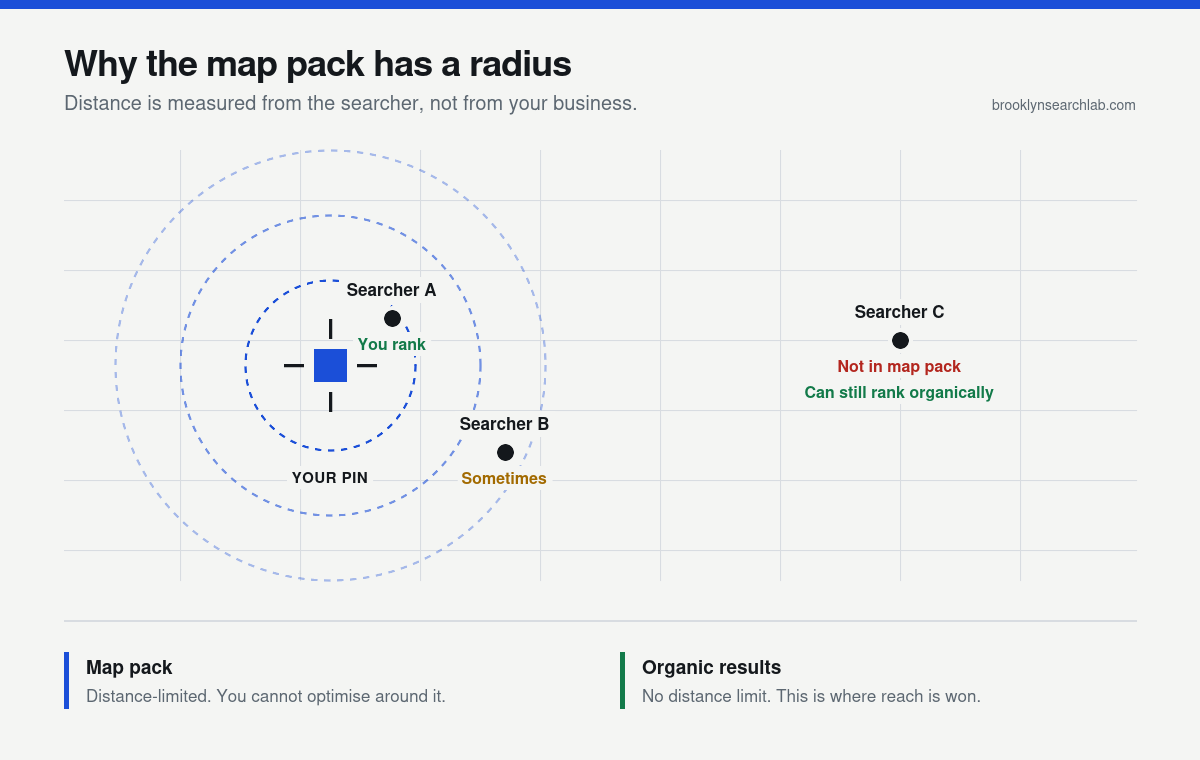
The searcher is the centre of the map, not you
This is the part that trips people up. Most business owners picture the map pack as a ranking of businesses in an area. It is not. It is a ranking of businesses relative to one specific point, and that point moves with every searcher.
When someone in Sheepshead Bay searches, you are close, so distance works in your favour and your relevance and prominence decide whether you beat the other nearby options. You rank first.
When someone in Midtown searches the same words, you are eight miles away and competing against dozens of businesses within a few blocks of them. Distance now works against you so heavily that no amount of relevance or prominence closes the gap.
Same profile. Same optimization. Completely different result, because the centre of the map moved.
A useful test. Search your main keyword from your own phone at your office, then search the identical phrase standing in the neighbourhood you want to win. If you rank at one location and vanish at the other, you are looking at distance, not a broken profile. Nothing needs fixing.
New York makes this brutal
Proximity matters everywhere, but density decides how punishing it is.
In a small city, the nearest ten businesses in your category might be spread across fifteen miles, so a strong profile eight miles out still competes. In Manhattan, there may be forty businesses in your category within a single square mile. The effective radius where you can realistically appear collapses to something very small, sometimes only a handful of blocks.
That is why a Brooklyn business with better reviews, better categories, and a better website still loses the Midtown map pack to a mediocre competitor who happens to be around the corner from the searcher. It is also why SEO in Brooklyn and SEO in Manhattan are genuinely different problems requiring different strategies, rather than the same playbook with the borough name swapped. We pulled that comparison apart in Manhattan vs. Brooklyn SEO, where the density gap changes not only the radius but which channel is worth funding at all.
If your address is hidden, this gets stricter
If you run a service-area business, one where you travel to customers and have no storefront they can visit, Google hides your street address and ranks you from an approximate pin rather than your exact building.
Two consequences worth knowing:
- Your effective radius is generally narrower than a comparable storefront’s, because Google is working from a deliberately fuzzy location.
- Setting your service area to cover all five boroughs does not extend your ranking radius. The service area field tells customers where you will travel. It is not a ranking input. This is probably the most widespread misconception in local SEO.
If you have a genuine staffed location that customers can visit during posted hours, you should be a storefront listing, not a service-area business. If you do not, you should not fake one. Google’s guidelines for representing your business are strict on this, and address violations are the most common cause of listing suspension. Reinstatement is slow and not guaranteed.
What you can actually control
Since distance is fixed, everything worth doing sits in the other two factors. Within the radius where you can compete, these decide whether you take one of the three slots.
Categories
Your primary category carries more weight than any other field on the profile. Most businesses set one and never revisit it. It is the first of several map pack ranking factors nobody tells small business owners about, and the cheapest one to get right. Check what your top-ranking competitors use, and add every relevant secondary category, but do not add categories you do not genuinely serve.
Reviews
Count matters, but recency and rate matter more than people expect, and the threshold is lower than most owners assume: we counted what actually ranks across NYC neighbourhoods and it was rarely the number being sold. Twelve reviews from three years ago reads as a dormant business. A steady trickle reads as an active one. Build a system that asks every satisfied customer at the right moment, and respond to all of them. Do not be tempted to buy reviews: it violates Google’s contribution policies, breaches FTC rules, and profiles get purged for it.
Citation consistency
Your name, address, and phone number must match character for character everywhere they appear. “Suite 200” on one directory and “Ste 200” on another is a real inconsistency signal. This work is tedious and unglamorous and it genuinely moves rankings.
Your website
Your site corroborates your profile. LocalBusiness structured data, a matching NAP block in the footer, and pages that give Google a reason to associate you with specific neighbourhoods all reinforce the listing. If your site is slow or badly built, that undermines the profile too, which is where web design and technical SEO stop being separate problems.
The part most agencies skip: win organic instead
Here is the strategic point that changes what you should be spending on.
Proximity applies to the map pack. It does not apply to organic results.
The blue links below the map are ranked on relevance, content quality, and authority, not on how far you are from the searcher. A Brooklyn business can rank first organically for a Manhattan query. It happens constantly.
So the correct strategy for a market outside your radius is not to keep pushing the profile. It is to build dedicated location pages that win the organic result for that market, with content genuinely specific to it rather than a template with the borough name swapped in.
It is also why multi-location businesses keep losing to single-location competitors: they stretch one profile across markets it cannot reach instead of giving each market a page that can win organically.
The short version
- Inside your radius: compete in the map pack. Categories, reviews, citations, profile completeness.
- Outside your radius: compete organically. Dedicated location pages, real local content, authority.
- Never: pay anyone promising map pack rankings across all five boroughs from one location. It is not achievable, and quoting Google’s own three ranking factors back to them usually ends the conversation.
What to do this week
- Map your real radius. Run a rank grid, or search your main keyword from several points across the city. You will see where you appear and where you drop off. That boundary is your map pack territory.
- Fix relevance inside it. Audit your primary and secondary categories against the businesses currently outranking you.
- Start a review routine. Not a campaign. A repeatable habit tied to job completion.
- Audit your citations. Find every mismatched listing and correct it.
- Build organic pages for the rest. One page per service and area you want, written specifically, not duplicated.
Common questions
Can I rank in the map pack in a borough where I have no location?
Realistically, no, unless you are close to its boundary. You can rank organically there, which is often the better commercial outcome anyway.
Will adding more service areas help?
No. Service area is a customer-facing field describing where you travel. It is not a ranking signal, and expanding it will not extend your radius.
Would a second location fix it?
A genuine second location with staff, signage, and posted hours would give you a second pin and a second radius. A virtual office or mailbox would not, and using one is a suspension risk that is not worth taking.
Why does a competitor with worse reviews outrank me?
Usually because they are closer to whoever is searching. Try the same search from directly outside their premises and you will often find the order reverses.
Want to see your actual radius? We run a rank grid across your service area, audit your profile against every ranking factor, and check your citations, so you know exactly where the map pack is winnable and where you need to win organically instead. It is free and you keep the findings.
Request your free local visibility audit
Related: Google Business Profile Optimization · SEO in Brooklyn · SEO in Manhattan · SEO Services