
The most-reviewed plumber within three kilometres of our Homecrest office has 643 reviews. On 18 August 2026 we asked Google for the local pack for “plumber” in Brooklyn. It showed three businesses with 51, 231 and 32 reviews. The 643 was nowhere.
Every business owner who has ever chased reviews wants the same thing: a number. Get to fifty and you are competitive. Get to a hundred and you win. It is the most common question we are asked about Google Business Profile optimization, and the honest answer is uncomfortable.
There is no number. There is a competitive set, and it is drawn by a radius around whoever is searching.
What we actually measured
We pulled every claimed business in the plumbing category inside a three kilometre circle around our own office, then did the same around Midtown Manhattan, then asked Google what it actually returns for the bare query “plumber” in each borough. Same trade, same day, two circles.
Around Homecrest there are 66 claimed plumbers. Their review counts run from 643 at the top down to 39 in tenth place. The three businesses Google actually put in the pack had 51, 231 and 32.
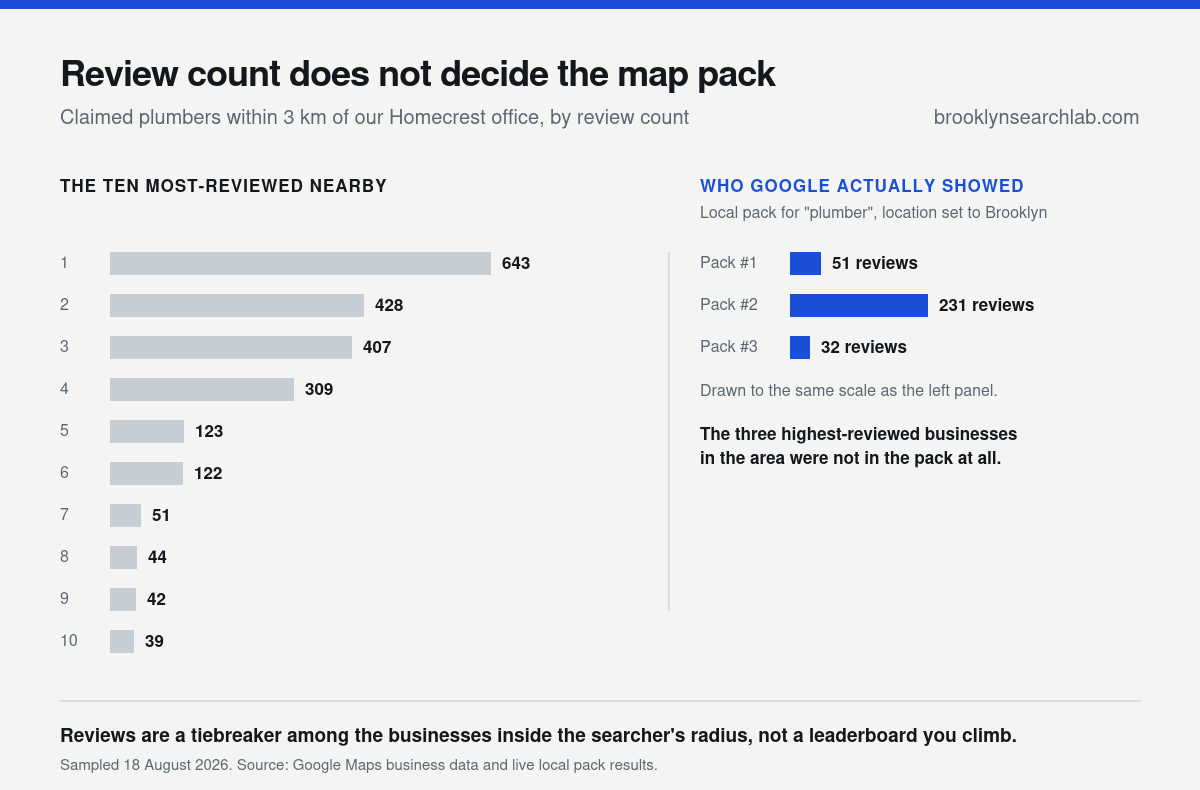
Two businesses in that pack would not make the top ten by review count in their own neighbourhood. One of them, with 32 reviews, would come last on that list. They are there anyway, because review count is not the thing being ranked.
What Google says reviews do, and what it does not say
Google’s local ranking guidance names three factors: relevance, distance, and prominence. Reviews sit inside prominence, alongside links, articles, directories and your general standing on the web. Google states plainly that review count and review score factor into local ranking.
What it does not say, anywhere, is that more reviews beat closer. That single omission is where most review strategies go wrong.
Distance is not a tiebreaker applied at the end. It is one of the three inputs, and in a city where a searcher may have forty qualifying businesses within a mile, it is the input that does the most cutting. Reviews decide who wins among the businesses that survive the distance filter. They do not get you into the filter.
This is why review campaigns stall. A business ten miles from its target neighbourhood adds two hundred reviews, sees nothing move, and concludes reviews do not work. Reviews worked fine. They were applied to a search the business was never eligible for. We wrote about this failure mode in detail when we explained why a profile can rank first in Brooklyn and vanish in Manhattan.
The number is different in every neighbourhood
Compare the two circles we sampled and the point makes itself.
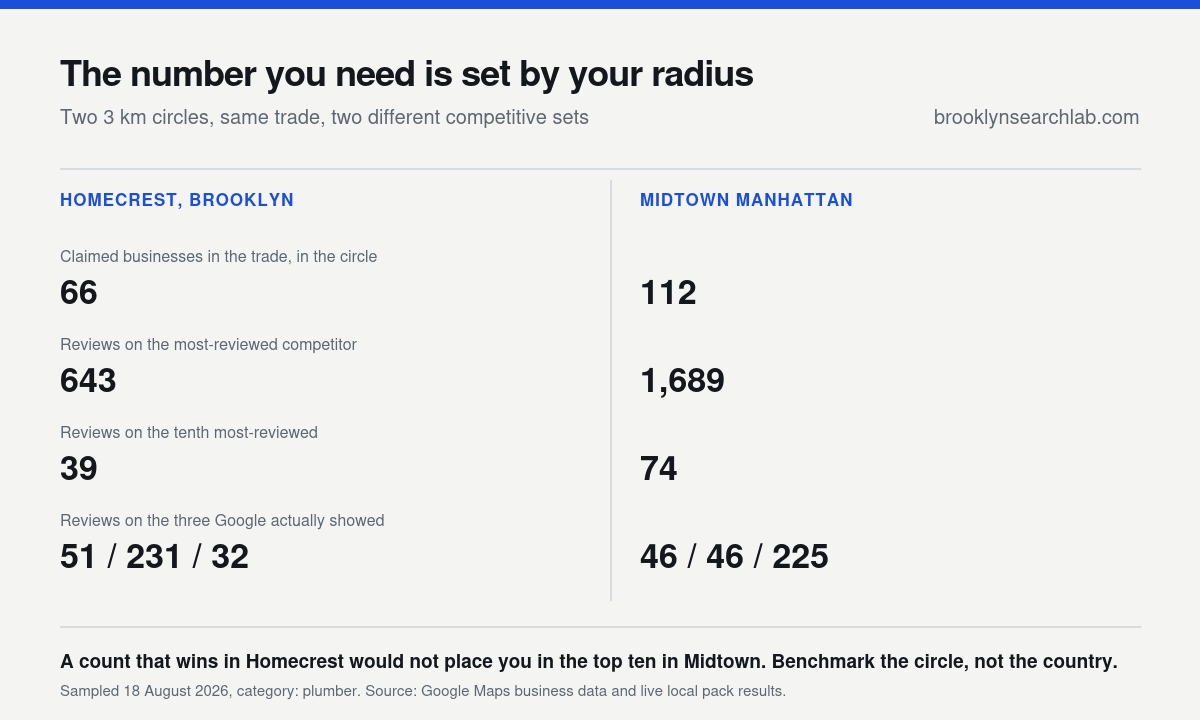
Midtown has 112 claimed plumbers in the same size circle, nearly double. The most-reviewed has 1,689. Tenth place has 74, which is almost twice what tenth place holds in Homecrest.
A count of 51 reviews put a business in the Brooklyn pack on the day we looked. The same 51 would not place it in the top ten most-reviewed businesses in Midtown, let alone win anything. This is the same structural asymmetry that makes SEO in Brooklyn and SEO in Manhattan genuinely different problems rather than the same plan run twice.
So the useful question is not “how many reviews do I need”. It is “how many do the businesses currently winning the searches I care about have, and how far away are they”. That is a fifteen minute exercise and it gives you a real target instead of a borrowed one.
Four review signals that matter more than the total
Once you stop treating reviews as a scoreboard, four things become more useful than the running total.
Recency and velocity
Sixty reviews collected over four years reads differently to sixty collected in the last eight months. A profile whose most recent review is fourteen months old signals a business that may not be operating. Steady arrival matters more than the cumulative figure, and it is the one thing a competitor with a big historic total often cannot match.
The shape of the rating, not the average
A 4.7 with a visible spread of fours and fives is more persuasive to a human than a flawless 5.0 built from nine reviews. Perfect averages on low volume read as curated. Every business in the two packs we sampled sat between 4.7 and 5.0, which tells you the rating is table stakes rather than a differentiator.
What the reviews actually say
Review text is indexed content attached to your profile. A review that says “replaced a burst pipe in our Sheepshead Bay basement on a Sunday” contains the service, the neighbourhood and the urgency. Ten of those do more for relevance than fifty saying “great service”. You cannot script this, but you can ask a question specific enough to prompt it.
Owner replies
Replies are the cheapest signal on this list and the most consistently skipped. They demonstrate an active, monitored profile, and they are the only part of a review you control. Google’s own guidance on getting more reviews pushes owners toward responding as part of normal profile maintenance.
The trap: buying the number you were chasing
Once someone believes a threshold exists, buying reviews starts to look like a shortcut past it. It is worth being blunt about what that costs.
Fake and incentivised reviews are prohibited outright under Google’s prohibited and restricted content policy, and enforcement removes the reviews rather than just declining to count them. Worse, since 2024 the Federal Trade Commission has had a final rule banning fake reviews and testimonials, with civil penalties attached. This stopped being a platform policy question and became a legal one.
The gentler version of the same mistake is a review gate: asking happy customers for a public review and unhappy ones for private feedback. It is common, it is against policy, and it produces exactly the too-perfect rating profile that makes a listing look bought.
What this means if you are not close enough to rank
Here is the part most agencies leave out, because it does not sell a review campaign.
If the searches you want are centred somewhere you are not, no volume of reviews will fix it. Our own pin sits in Homecrest, about ten miles from Midtown, and no amount of review work will place us in a Midtown map pack. We say so on our areas served pages because it is verifiable and pretending otherwise would be the first thing a competent prospect checks.
What works instead is splitting the job. Reviews, proximity and profile accuracy carry the boroughs where your pin genuinely competes. Organic location pages carry the boroughs where it does not, because organic results are not proximity-weighted the way the map pack is. That is a content and technical SEO problem, not a reputation problem, and confusing the two wastes a year.
How that split is weighted changes by borough more than most owners expect, which is why Manhattan and Brooklyn need genuinely different plans rather than the same one run twice.
The other prerequisite is that your listing has to be eligible and consistent in the first place. A profile with the wrong listing type, or an address that renders differently across directories, leaks the prominence your reviews are building. We covered both in storefront versus service area setup and in why NAP consistency still moves rankings.
Key takeaways
- There is no threshold. On the day we sampled, the Brooklyn pack held businesses with 32, 51 and 231 reviews.
- Your benchmark is a radius, not a borough. Tenth place near Homecrest holds 39 reviews; in Midtown it holds 74.
- Reviews sit inside prominence. They decide who wins among businesses close enough to qualify. They do not extend your radius.
- Velocity beats total. A steady arrival of recent reviews outperforms a large historic count that stopped growing.
- Review text is indexed. Specific service and neighbourhood language does work that generic praise does not.
- Buying reviews is now a legal exposure, not only a policy one, under the FTC’s 2024 rule.
What to do this week
- Find your real benchmark. Search your main service term from a phone in the neighbourhood you want, and write down the review count of all three pack results. That is your target, not an industry average.
- Check your velocity, not your total. Open your profile and find the date of your most recent review. If it is more than two months old, that is the problem to fix.
- Reply to every review you have. All of them, including the old ones and especially the negative ones. This is a single afternoon.
- Ask a better question. Replace “please leave us a review” with “if you have a minute, mention what we fixed and where”. It produces text that carries relevance.
- Make the ask systematic. A request that goes out reliably after every job beats an occasional push, which is why we usually solve this with workflow automation rather than a reminder in someone’s calendar.
Common questions
Is there a minimum number of reviews to appear in the map pack?
No. Google publishes no threshold, and our sample found ranking businesses with as few as 32 reviews. Eligibility comes from a complete, verified profile that meets Google’s guidelines for representing your business, in a category that matches the query, close enough to the searcher.
Do reviews on Yelp or Facebook count?
They contribute to the wider web presence Google describes as prominence, which it says it draws from links, articles and directories across the web. They do not appear in your Google review count and they will not move the map pack the way Google reviews do.
How fast can I add reviews without looking suspicious?
The risk is not speed, it is pattern. Twenty reviews in a week from accounts with no history, all five stars, all short, is a filtered burst. Twenty over the same week from real customers you actually served is fine. Ask everyone, consistently, rather than in campaigns.
Should I ask customers to mention my service or neighbourhood?
You can ask what they want to talk about, which often surfaces the service and location naturally. You cannot supply the wording or offer anything in exchange. The line is between prompting a real review and authoring one.
What about a single negative review?
One critical review among many positives rarely hurts and often helps, because it makes the rest credible. What hurts is a critical review with no reply, which reads as a business that stopped paying attention.
Do reviews help my website rank, or only the map pack?
Primarily the map pack and the profile itself. There is an indirect effect on the site, because a profile Google trusts sends clearer signals about the entity behind the site. It is not a substitute for the on-page and technical work that decides organic position.
Want your actual number?
The free audit includes a local benchmark: who is currently ranking for your terms in the neighbourhoods you care about, how many reviews they have, how far they are from you, and whether the map pack is realistically reachable from your pin at all. Five business days, no obligation.
Related: Google Business Profile optimization, SEO in Brooklyn, who we are.